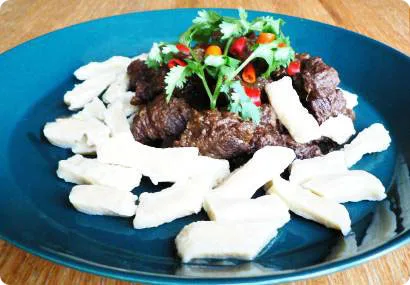
Olen kuolannut unkarilaisen Chili & Vanilia -ruokablogin kuvia jo kuukausia, joten kun sieltä löytyi vielä englanniksi juttu siitä, mitä unkarilainen gulassi on ja mitä se ei ole, pörkölt muistui taas mieleen, ja ohjetta oli tietysti päästävä kokeilemaan heti viikonloppuna. Pörkölt on se liharuoka, jota me ei-unkarilaiset kutsumme gulassiksi. Tuon matkoilta mieluiten syötäviä tuliaisia, ja Budapestista hamstraamani unkarilainen paprikajauhe odotti yhä käyttäjäänsä kaapissa. Koska epäilin sen jo ehtineen vähän väljähtyä, heitin joukkoon pikkuruisen kuivatun chilin, joka antoi kastikkeelle hienovaraista tulisuutta.
Netistä etsin myös ohjeita unkarilaisiin nuudeleihin eli galuskaan. Ne tehdään pehmeästä taikinasta omalla välineellään, galuskaszaggatólla, joka on lähes sama kapine kuin spätzle-höylä. Sellaista olen aina himoinnut, mutta keittiöstäni sitä ei löydy, joten tein tavallisen, vähän kiinteämmän pastataikinan ja leikkasin nuudelit käsin. Muhennoksen ohje on Chili & Vanilian, pienin muutoksin.
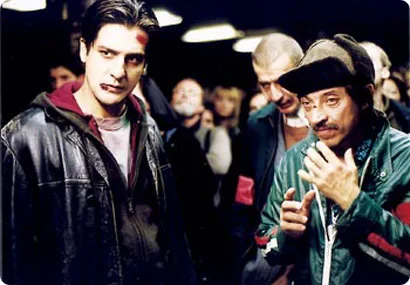
Hitaasti haudutettu muhennos oli juuri sellaista lohturuokaa, joka kulkee sukupolvelta toiselle. Äitini ja mummonikin olisivat voineet tehdä ja syödä sitä ihan omana ruokanaan (chiliä lukuun ottamatta), ja minä aion ehdottomasti tehdä sitä uudestaan. Ohjeen salainen vaihe on nostaa kasari pois liedeltä ennen kuin paprika lisätään, ja se tosiaan esti paprikaa palamasta. Aiemmista, vähemmän onnistuneista kokeiluista muistan kitkerän maun liiankin hyvin. Kontroll on omalaatuinen kauhuelokuva, joka on kuvattu kokonaan Budapestin kauniin vanhanaikaisessa metrossa (siinä on muuten viime vuosien elokuvista hienoimpia arkkitehtuurikuvia), ja siinä yksi kaurismäkimäisistä päähenkilöistä luettelee ulkoa porsaansorkkareseptin, jossa on tismalleen sama salainen vaihe. Ei se taida niin salainen ollakaan 😉
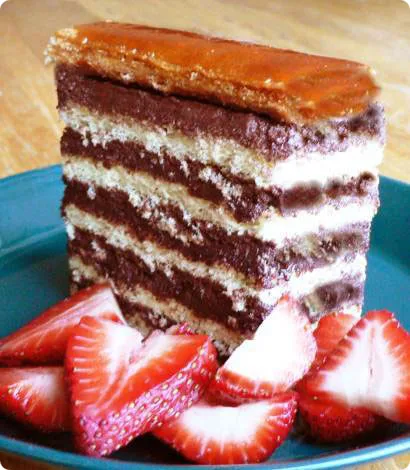
Arkeni pyörii tiukasti Manhattanin länsilaidalla, lähinnä Morningside Heightsissa, Länsi-Harlemissa ja Washington Heightsissa, jotka jäävät aika tukevasti turistikartan ulkopuolelle. Aurinkoinen sää houkutteli rikkomaan kaavan, ja kävelin Harlemin ja El Barrion halki Upper East Sidelle etsimään sopivaa jälkiruokaa Yorkvillestä, entisestä keskieurooppalaisesta kaupunginosasta. 86. katu oli valitettavasti kokonaan samojen ketjuliikkeiden vallassa, joita näkee joka amerikkalaisessa pikkukaupungissa. Gapit, Banana Republicit ja Barnes & Noblet olivat melkein peittäneet alleen sen, mikä kuulemma oli joskus ollut Pikku-Saksa. Jotain oli silti jäljellä. Toisella avenuella poikkesin vuonna 1937 perustettuun Schaller & Weber -herkkukauppaan, jossa saksaa puhuvat hausfraut ostivat pumpernickeliä ja hanhenmaksamakkaraa. Niin minäkin, ja samalla huomasin kaupassa yllättävän laajan pohjoismaisen valikoiman, muun muassa puolen tusinaa sorttia marinoitua silliä ja ruotsalaisia Läkerol-pastilleja. Seuraavassa korttelissa näkyi vihdoin unkarilainen leipomo. Se näytti upouudelta eikä todellakaan miltään sotaa edeltäneen ajan jäänteeltä. Kakut olivat herkullisen ja täyteläisen näköisiä, mutta lempikakkuani dobostortaa ei näkynyt. Osa leivoksista oli lisäksi kutistemuovissa, eikä se ole koskaan hyvä merkki.
Luovuin Unkarista ja tyydyin seuraavaksi parhaaseen eli Neue Galerien pikkuruiseen saksalaiseen kirjakauppaan 86. kadun ja Viidennen avenuen kulmassa. Sen ohi kulkee helposti huomaamatta, vaikka asuisi naapurissa. Siellä on upeita kirjoja, joita en huomaisi missään muualla. Itse museo on aivan pieni, mutta kokoelmissa on loistavaa itävaltalaista ja saksalaista taidetta 1900-luvun alusta, muiden muassa Klimtiä, Schieleä, Groszia ja Dixiä. Samassa talossa on myös ihana Café Sabarsky, jossa on kovin wieniläinen tunnelma ja jossa kirjakaupan löytöjä on juuri sopiva selailla. Tuskin silti menen sinne enää koskaan, sillä viime talvena sain heidän Weisswurst-makkarastaan rajun ruokamyrkytyksen.
Kotimatkalla bussi M4 mateli Central Parkin pohjoisreunaa pitkin, ja tajusin, ettei omalta kulmalta olisi tarvinnut lähteä minnekään. Bussin ikkunasta bongasin 110. kadun ja Amsterdam Avenuen kulmassa The Hungarian Pastry Shopin. Se on töitään pakoilevien opiskelijoiden ikisuosittu hengailupaikka, siellä on kuvattu yksi kohtaus Woody Allenin elokuvaan Husbands and Wives, ja dobostortaa sieltä saa ihan varmasti.
Reseptikortti
Pörkölt - liharuoka, jota me ei-unkarilaiset kutsumme gulassiksi
- 4 annosta
- Haudutus 1-1,5 h
- Kiehautus ilman kantta 10-15 min
Tarvitset
| 1 kg | pitkään haudutukseen sopivaa kuutioitua naudanlihaa, esim. naudan lapaa |
| 2 | isoa sipulia hienona silppuna |
| 4-5 rkl | ruokaöljyä (rypsiöljyä) |
| 3-4 rkl | unkarilaista paprikajauhetta |
| 1 | vihreä paprika viipaleina |
| 1 tl | suolaa |
| 1 tl | vastajauhettua mustapippuria |
| (1) | pikkuinen kuivattu chilipippuri |
Tee näin
- Kuumenna öljy isossa paistinkasarissa. Kuullota hienoksi hakattu sipuli.
- Ota kasari pois tulelta ja hämmennä paprikajauhe sipuliin (tämä vaihe on oleellinen, se estää paprikaa palamasta kitkeräksi karstaksi).
- Laita kasari takaisin lämmölle ja sekoita joukkoon lihapalat niin, että ne peittyvät kauttaaltaan sipuli-paprikaseokseen.
- Lisää 1-1,5 dl vettä - veden ei tarvitse peittää lihaa kokonaan. Lisää myös vihreä paprika, suola ja pippuri (ja chilipippuri).
- Hauduta kannen alla matalalla lämmöllä 1-1,5 tuntia. Tarkista tunnin kohdalla ja lisää vettä tarvittaessa, jos näyttää siltä, että muhennos on kuivumassa kattilan pohjaan.
- Jos muhennos on vielä kovin vetistä, kun liha on pehmennyt, kiehuta sitä ilman kantta 10-15 min kovemmalla tulella, niin että liika neste haihtuu pois ja jäljelle jää paksu, mausteinen kastike lihan pinnalle.
- Tarjoa tuorepastan kanssa - unkarilaisten perinteenä on tehdä tämän kanssa pehmeästä pastataikinasta galuska-nuudeleita. Muhennos paranee vielä maultaan seisottuaan yön yli ja lämmitettynä.

17 kommenttia
Oh, Anna dear, what a great surprise to see this post and that you treated yourself with a Hungarian meal! And that you're even mentioning Kontroll, which is one of the best Hungarian movies of the last few years indeed, I'm so impressed..I'm glad you liked the recipe, I think I'm going to adjust that goulash post with a proper galuska recipe. Oh yes, the Hungarian Pastry shop..when I lived in New York, I lived at the Upper West Side (90th) and I also sometimes went there. Or to Mocca on the east side..Thank you for this post! Take care, Zsofi
Zsofi, I've rarely eaten anywhere as consistently well as in Budapest. Hoping to return soon... Your blog is so beautiful I should actually learn some Hungarian to get the full benefit 😉 From afar, I always confuse your language with mine because the cadence is so similar. In the meantime, if you post a recipe for galuska in English, I'll learn to make them - deal?
Sadly, I think Mocca is no more - I think I heard it passed away last year.
Anna,
You should give tours of New York ... I loved the food trip through the city.
This post reminds of a book I've been meaning to buy called, "The Lost Art of Baking with Yeast: Delicious Hungarian Cakes and Pastries" by Baba Schwartz.
Even though we're in Canada and our background is Italian, I was lucky to have a father who made sure that our food horizons were as broad as possible.
I remember trying beautiful Hungarian food as a little girl. It's been awhile as most of the places are either gone or in parts of the city that I never make time for (sadly).
But you've reawakened that desire. Thanks, Anna. And thanks for the tip about Chili&Vanilla. I will check that out.
By the way, there is a book by a Canadian writer, published in February 2006, called "Paprika: A Spicy Memoir From Hungary" by Joanne Sasvari. You may be interested!
Ivonne,
thanks for the wonderful book suggestions. I will definitely check them out, the Paprika book in particular. (If you happened to see it in a bookstore in Toronto, please let me know where - I'll be there later this week and although I'm officially over quota with cookbooks I can always justify a souvenir.)
A few years ago I had a Croatian-American neighbor. We did some Christmas baking together and I realized that the delicacies she learnt from her mom the very same Austro-Hungarian treats I learned to love when I spent some time in Austria as a student. Actually, a very dear friend from Vienna gave me the wonderful Die Gute Küche by Plachutta and Wagner, *the* Austrian cookbook, as a wedding present. It's wonderful... IMHO, the most delicious cakes and pastries and in all Europe hail from Austria, Hungary, and Germany.
Anna, you don't really need a "galuskaszaggató" for making those noodles. After making the original soft(!) dough, put part of it on a cutting board, arrange it in a long, thin stripe, and in one movement cut down the end of the stripe and push the little piece into the boiling water with the blunt edge of a knife. Cut and push, cut and push again. (I hope you get the idea.) It needs some practising to get it right and do it fast enough. You can try with more stripes....
This is the traditional way these "dumplings" are done. Hungarian chefs do it like that (and so does my granny)!
Hei Anna, hauskaa lukea unkarilaisista ruoista, filmeistä ym. taikinapojan luona! Ja onnittelut galuskaszaggatón oikeinkirjoituksesta. And I join t3v in remembering various old relations and non-related ladies from my childhood who made galuska on a simple wooden board at the speed of light. Kevätterveisin, Eszter
Anna, where did you eat so "consistently well" in Budapest? If you remember some places I would be very much interested to know which restaurants you liked here in Budapest. Yours would be an expert opinion and also a good lead-on for foreign guests looking for a place to eat.
Eszter: I also had wonderful meals in Budapest during the two week-long business trips I made there two years ago. I wish I'd remember the names (I have to go trough my old recipes) - but I especially remember the delicious goose legs on the (main?) restaurant street near the big market hall. There also was a very nice bar, where you were offered peanuts, and you could throw the broken shell on the floor covered by straws (very fire-unfriendly!!!). Naturally the restaurant at Hotel Gellert was exquisite. I also went to this medieval restaurant, where the staff was dressed accordingly. Very nice indeed 🙂
Hi Antti,
this nice bar is called For Sale (Vamhaz korut is the name of the street), the other restaurant I don't know.
Anna, I find your blog really great:-)
Eszter & Noemi: I found the restaurant names from my old expense reports. You were right about the For Sale bar. Great beer, great food and nice live music.
The one with the fabulous goose legs (Roasted Goose Leg with potatoes Bataszeki style and red cabbage, steamed in Törley sparkling wine, Martonvasarhelyi style) was Vörös Postakocsi on Ráday u. I ate there several times, as I was staying in a very nearby hotel on Kálvin tér.
The medieval place was Sir Lancelot.
The restaurant at Hotel Gellert was superb, albeit twice as expensive as the orhers. Nonetheless, the service and food were first class, and dining al fresco on their terrace was very enjoyable.
Hi Eszter, I've been away from Finland for the better part of the last three years: during that time the restaurant scene in Helsinki has changed almost completely, and I can no longer recommend where to go and where not to go. So I'm sure Budapest has changed a lot, too. Maybe even my personal tastes have changed...
I just remember very fondly the variety and vibrance of the restaurants of Raday utca around the turn of the millennium. (Andras Török's Guide to Budapest and the Finnish Sankarimatkaajan Budapest were great reads, although I can't remember anymore whether they recommended any restaurants.) I'm sure I missed many bastions of haute cuisine in the city but I was just so pleasantly surprised by the friendliness, innovation and high level of service I found in a string of eateries along that street and nearby. I loved the cafe / bar Paris Texas for example. My next visit is long overdue - but when I do get around, I will definitely tell you which places currently appeal to me.
Another matter is that I'm happiest when I stumble on places that are not packed with busloads of fellow travellers. I've grown to appreciate neon-lit street kitchens and anonymous little places. And, inevitably, the most memorable travel-related meals tend to take place when visiting friends abroad, whether enjoying the freshest seafood in a crumbling palazzo in Venice, a supper of ham and cheese prepared by the housemaid in a highrise in Rio de Janeiro, or a plateful of homemade mämmi (yesterday in Toronto, among several generations of Finnish-Canadian immigrants gathered together for the Palm Sunday service).
t3v and Eszter: thanks for the galuska tips - I agree that an afternoon with someone's grandma would be the right way to learn... or maybe a video clip...
Vörös Postakocsi sounds really familiar... I dimly remember a superb waiter who suggested truly stunning Hungarian wines. Really, I should visit Budapest again ASAP - and when I do I'll ask you all where to go 😉
Anna,
should you come, just ask where to get a galuskaszaggató:-) (I don't like the grandma-style, it's too hard for me...)
Noemi,
Thanks for giving me the green light 😉 I love kitchen gadgets far too much to pass up the opportunity to get a new one...
Hei Anna ja Antti and thanks for going into such details on the Budapest restaurant scene. My experience is that visitors often know better and given your gastronomic inclinations, it was very interesting how you reflect on our eateries. My, what a challenge it would be to recommend places to you. But I'd happily oblige if and when you happen to come to this part of the world.
For the Magyarophiles on this site, I noticed this morning leafing through the weekend papers that a reporter from NY Times explored whatever remains of Little Hungary in New York. No, he didn't find much either. He relates: "Mocca closed in 2004, facing rising rents. But, displaying American pragmatism, it merged with a diner a few doors down, and the unlikely alloy is called Frankie's and Mocca. You can have goulash, while the table next to yours is having a tuna melt. [There is a] Mexican chef who has been cooking Hungarian for 20 years. The nockerl was as good as I remembered, and the palacsintas only slightly less so."
Yorkville Meat Emporium (2nd Ave at 81st St) apparently sells potato bread and stuffed cabbage, but sadly most of the former patrons have passed away. And if you are interested in finding the Hungarian versions of Playboy and Cosmo, go to Blue Danube Gifts on East 83rd Street 😉
[...] Más: egy kis internacionális update: a finn Anna New York-ban pörköltet főz, Kontroll-t néz és Dobos tortát eszik. Hát nem isteni? [...]