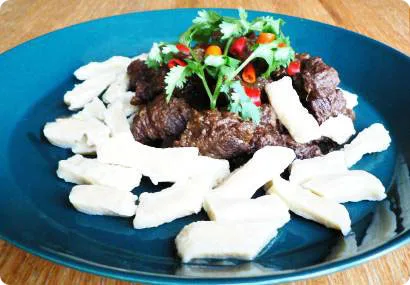
I have been drooling over the photographs on the Hungarian food blog Chili & Vanilia for months, so when I found the story of what Hungarian goulash is and what it is not there, in English no less, I remembered pörkölt all over again and naturally had to try the recipe over the weekend. Pörkölt is the meat stew that we non-Hungarians call goulash. I'm all about edible souvenirs, and I was eager to use up the Hungarian paprika I had hoarded on a visit to Budapest. Fearing that it might have gone a bit stale, I threw in a tiny dried chilli, which gave the sauce a subtle fire.
I also scoured the internet for instructions for Hungarian noodles, galuska. They are made from a soft dough with a tool of their own, a galuskaszaggató, very similar to a spätzle maker, which is a kitchen gadget I have always wanted. Lacking one, I had to resort to a firmer, ordinary pasta dough that I cut by hand. The stew is Chili & Vanilia's recipe, with slight modifications.
The slow-cooked stew had a soothing, transgenerational feel to it. My mother and grandmother would be perfectly at home making and eating it (minus the chilli), and I will certainly make it again. The secret step is to take the pan off the heat before the paprika goes in, and it really did keep the paprika from burning. I remember the bitter taste of earlier, not-so-successful experiments all too well. By the way, in the off-beat horror film Kontroll, shot entirely in the timelessly elegant Budapest metro (it has some of the coolest architectural shots of any film in recent memory), one of its Kaurismäki-like main characters recites a recipe for pig's trotters that quotes the very same secret step. So perhaps it is not so secret after all 😉

My everyday life is totally entrenched on the West Side of Manhattan, mostly in Morningside Heights, West Harlem and Washington Heights, areas pretty firmly off the tourist map. Inspired by the sunny weather, I decided to break the mould and walk across Harlem and El Barrio to the Upper East Side, in search of a suitable dessert in Yorkville, once a Central European enclave. Unfortunately, 86th Street turned out to have been taken over entirely by chain stores from Middle America. The likes of Gap, Banana Republic and Barnes & Noble all but hid what was apparently once Little Germany. Some traces remained. On Second Avenue I stopped at the Schaller & Weber delicatessen, established in 1937, where German-speaking Hausfrauen were shopping for pumpernickel and goose liverwurst. So did I, and I also noticed that the deli had a fairly impressive range of Nordic products, including half a dozen kinds of pickled herring and Swedish Läkerol pastilles. In the next block I finally spotted a Hungarian bakery. It looked brand new, certainly no relic of the pre-war years. The cakes inside looked delicious and rich, but I couldn't spot Dobostorta, my favourite. Some of the pastries were shrink-wrapped, too, which is never a good sign.
I gave up on Hungary and settled for the next best thing, one of the well-hidden gems of the neighbourhood, the tiny German bookshop at the Neue Galerie on 86th Street and Fifth Avenue, which has exquisite books I would never notice anywhere else. The museum itself is very small, yet it has superb Austrian and German art from the early twentieth century, Klimt, Schiele, Grosz and Dix among others. It is also home to the lovely Café Sabarsky, very Viennese in atmosphere and just the place to browse one's finds from the bookshop, although I doubt I will ever venture there again, because last winter their Weisswurst gave me a violent bout of food poisoning.
On the way home, on a bus slowly inching along the northern edge of Central Park, I realised I need not have left my own neighbourhood at all. From the window of the M4 I caught sight of The Hungarian Pastry Shop on 110th and Amsterdam, the ever-popular hangout of procrastinating students, the backdrop to a scene in Woody Allen's Husbands and Wives, and certainly a home of Dobostorta.

Recipe card
Pörkölt - Hungarian Beef Stew
- 4 servings
- Simmering 1-1.5 h
- Reducing, uncovered 10-15 min
You will need
| 1 kg | beef for stewing, cubed, e.g. shoulder (chuck) |
| 2 | large onions, finely chopped |
| 4-5 tbsp | canola oil |
| 3-4 tbsp | Hungarian paprika powder |
| 1 | green pepper, sliced |
| 1 tsp | salt |
| 1 tsp | freshly ground black pepper |
| (1) | peperoncino, or a small dried chilli |
Method
- Heat the oil in a large saucepan. Add the finely chopped onions and cook until translucent.
- Now comes an important secret step: take the saucepan off the heat and only then stir in the paprika. If you did this on the heat, the paprika could burn from the sudden heat and turn bitter.
- Put the pan back on the heat, add the beef cubes and stir so that the spicy onion mixture coats the meat evenly.
- Add about 100-150 ml of water, so that the liquid does not cover the meat completely. Add the sliced green pepper, salt and black pepper (and the peperoncino, if using).
- Simmer covered on a very low heat for about 1-1.5 hours. After an hour, check and add a little more water if necessary, so that the stew does not burn.
- Depending on how thick the sauce is, cook uncovered for 10-15 minutes so that the liquid reduces and all you have left is a spicy, thick sauce coating the meat.
- Serve with fresh pasta; the Hungarian tradition is galuska noodles made from a soft pasta dough. The stew tastes even better the next day, reheated.

17 comments
Oh, Anna dear, what a great surprise to see this post and that you treated yourself with a Hungarian meal! And that you're even mentioning Kontroll, which is one of the best Hungarian movies of the last few years indeed, I'm so impressed..I'm glad you liked the recipe, I think I'm going to adjust that goulash post with a proper galuska recipe. Oh yes, the Hungarian Pastry shop..when I lived in New York, I lived at the Upper West Side (90th) and I also sometimes went there. Or to Mocca on the east side..Thank you for this post! Take care, Zsofi
Zsofi, I've rarely eaten anywhere as consistently well as in Budapest. Hoping to return soon... Your blog is so beautiful I should actually learn some Hungarian to get the full benefit 😉 From afar, I always confuse your language with mine because the cadence is so similar. In the meantime, if you post a recipe for galuska in English, I'll learn to make them - deal?
Sadly, I think Mocca is no more - I think I heard it passed away last year.
Anna,
You should give tours of New York ... I loved the food trip through the city.
This post reminds of a book I've been meaning to buy called, "The Lost Art of Baking with Yeast: Delicious Hungarian Cakes and Pastries" by Baba Schwartz.
Even though we're in Canada and our background is Italian, I was lucky to have a father who made sure that our food horizons were as broad as possible.
I remember trying beautiful Hungarian food as a little girl. It's been awhile as most of the places are either gone or in parts of the city that I never make time for (sadly).
But you've reawakened that desire. Thanks, Anna. And thanks for the tip about Chili&Vanilla. I will check that out.
By the way, there is a book by a Canadian writer, published in February 2006, called "Paprika: A Spicy Memoir From Hungary" by Joanne Sasvari. You may be interested!
Ivonne,
thanks for the wonderful book suggestions. I will definitely check them out, the Paprika book in particular. (If you happened to see it in a bookstore in Toronto, please let me know where - I'll be there later this week and although I'm officially over quota with cookbooks I can always justify a souvenir.)
A few years ago I had a Croatian-American neighbor. We did some Christmas baking together and I realized that the delicacies she learnt from her mom the very same Austro-Hungarian treats I learned to love when I spent some time in Austria as a student. Actually, a very dear friend from Vienna gave me the wonderful Die Gute Küche by Plachutta and Wagner, *the* Austrian cookbook, as a wedding present. It's wonderful... IMHO, the most delicious cakes and pastries and in all Europe hail from Austria, Hungary, and Germany.
Anna, you don't really need a "galuskaszaggató" for making those noodles. After making the original soft(!) dough, put part of it on a cutting board, arrange it in a long, thin stripe, and in one movement cut down the end of the stripe and push the little piece into the boiling water with the blunt edge of a knife. Cut and push, cut and push again. (I hope you get the idea.) It needs some practising to get it right and do it fast enough. You can try with more stripes....
This is the traditional way these "dumplings" are done. Hungarian chefs do it like that (and so does my granny)!
Hei Anna, hauskaa lukea unkarilaisista ruoista, filmeistä ym. taikinapojan luona! Ja onnittelut galuskaszaggatón oikeinkirjoituksesta. And I join t3v in remembering various old relations and non-related ladies from my childhood who made galuska on a simple wooden board at the speed of light. Kevätterveisin, Eszter
Anna, where did you eat so "consistently well" in Budapest? If you remember some places I would be very much interested to know which restaurants you liked here in Budapest. Yours would be an expert opinion and also a good lead-on for foreign guests looking for a place to eat.
Eszter: I also had wonderful meals in Budapest during the two week-long business trips I made there two years ago. I wish I'd remember the names (I have to go trough my old recipes) - but I especially remember the delicious goose legs on the (main?) restaurant street near the big market hall. There also was a very nice bar, where you were offered peanuts, and you could throw the broken shell on the floor covered by straws (very fire-unfriendly!!!). Naturally the restaurant at Hotel Gellert was exquisite. I also went to this medieval restaurant, where the staff was dressed accordingly. Very nice indeed 🙂
Hi Antti,
this nice bar is called For Sale (Vamhaz korut is the name of the street), the other restaurant I don't know.
Anna, I find your blog really great:-)
Eszter & Noemi: I found the restaurant names from my old expense reports. You were right about the For Sale bar. Great beer, great food and nice live music.
The one with the fabulous goose legs (Roasted Goose Leg with potatoes Bataszeki style and red cabbage, steamed in Törley sparkling wine, Martonvasarhelyi style) was Vörös Postakocsi on Ráday u. I ate there several times, as I was staying in a very nearby hotel on Kálvin tér.
The medieval place was Sir Lancelot.
The restaurant at Hotel Gellert was superb, albeit twice as expensive as the orhers. Nonetheless, the service and food were first class, and dining al fresco on their terrace was very enjoyable.
Hi Eszter, I've been away from Finland for the better part of the last three years: during that time the restaurant scene in Helsinki has changed almost completely, and I can no longer recommend where to go and where not to go. So I'm sure Budapest has changed a lot, too. Maybe even my personal tastes have changed...
I just remember very fondly the variety and vibrance of the restaurants of Raday utca around the turn of the millennium. (Andras Török's Guide to Budapest and the Finnish Sankarimatkaajan Budapest were great reads, although I can't remember anymore whether they recommended any restaurants.) I'm sure I missed many bastions of haute cuisine in the city but I was just so pleasantly surprised by the friendliness, innovation and high level of service I found in a string of eateries along that street and nearby. I loved the cafe / bar Paris Texas for example. My next visit is long overdue - but when I do get around, I will definitely tell you which places currently appeal to me.
Another matter is that I'm happiest when I stumble on places that are not packed with busloads of fellow travellers. I've grown to appreciate neon-lit street kitchens and anonymous little places. And, inevitably, the most memorable travel-related meals tend to take place when visiting friends abroad, whether enjoying the freshest seafood in a crumbling palazzo in Venice, a supper of ham and cheese prepared by the housemaid in a highrise in Rio de Janeiro, or a plateful of homemade mämmi (yesterday in Toronto, among several generations of Finnish-Canadian immigrants gathered together for the Palm Sunday service).
t3v and Eszter: thanks for the galuska tips - I agree that an afternoon with someone's grandma would be the right way to learn... or maybe a video clip...
Vörös Postakocsi sounds really familiar... I dimly remember a superb waiter who suggested truly stunning Hungarian wines. Really, I should visit Budapest again ASAP - and when I do I'll ask you all where to go 😉
Anna,
should you come, just ask where to get a galuskaszaggató:-) (I don't like the grandma-style, it's too hard for me...)
Noemi,
Thanks for giving me the green light 😉 I love kitchen gadgets far too much to pass up the opportunity to get a new one...
Hei Anna ja Antti and thanks for going into such details on the Budapest restaurant scene. My experience is that visitors often know better and given your gastronomic inclinations, it was very interesting how you reflect on our eateries. My, what a challenge it would be to recommend places to you. But I'd happily oblige if and when you happen to come to this part of the world.
For the Magyarophiles on this site, I noticed this morning leafing through the weekend papers that a reporter from NY Times explored whatever remains of Little Hungary in New York. No, he didn't find much either. He relates: "Mocca closed in 2004, facing rising rents. But, displaying American pragmatism, it merged with a diner a few doors down, and the unlikely alloy is called Frankie's and Mocca. You can have goulash, while the table next to yours is having a tuna melt. [There is a] Mexican chef who has been cooking Hungarian for 20 years. The nockerl was as good as I remembered, and the palacsintas only slightly less so."
Yorkville Meat Emporium (2nd Ave at 81st St) apparently sells potato bread and stuffed cabbage, but sadly most of the former patrons have passed away. And if you are interested in finding the Hungarian versions of Playboy and Cosmo, go to Blue Danube Gifts on East 83rd Street 😉
[...] Más: egy kis internacionális update: a finn Anna New York-ban pörköltet főz, Kontroll-t néz és Dobos tortát eszik. Hát nem isteni? [...]