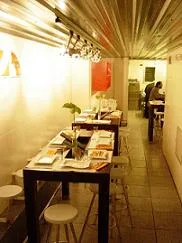
Not long ago I spent a few days in Barcelona. Although my work schedule was pretty hectic, we managed to squeeze in a memorable dinner at Cata 1.81 in Eixample. Great wine, countless miniature courses of delicious morsels, and effortlessly stylish surroundings that put to shame New York's wannabe Barcelonas [insert your favourite recently opened Lower East Side eatery here].
A great fast food solution in Barcelona was lunch at a humble Ecuadorian joint (c/ Calabria, near Gran Via, also in Eixample). They served wonderfully fresh avocado salads and ceviches. In fact, I'm totally obsessed with ceviches. They are the perfect summer food and a staple at Ecuadorian and Peruvian restaurants. My last week in New York was devoted to eating the food I'll miss the most, so one of my last meals there naturally involved a Peruvian salmon ceviche.
Peruvian food is among my all-time favourite cuisines, but I'm not counting on finding many Peruvian restaurants in Northern Europe. Hence I'm seriously contemplating buying this cookbook. When I left New York a month ago, my bags were bursting with pisco (the Peruvian grape brandy that goes into a pisco sour), ají amarillo (a fruity yellow chilli), mote blanco (big white kernels of dried corn that split open when boiled) and maíz de tostar, which is toasted into cancha, the crunchy corn eaten alongside a ceviche, all from the Trade Fair supermarkets in Queens. Luckily, a lovely check-in guy at JFK waived the excess baggage charges (30 kg / 66 lb - a fortune) when he realised how terribly I will miss all the great food I used to get so easily in Astoria and Jackson Heights. (Now that I read about the week-long Con Ed power failure that hit one of my favourite haunts in New York, I'm of course totally horrified, but also smugly happy that I barely managed to escape.)
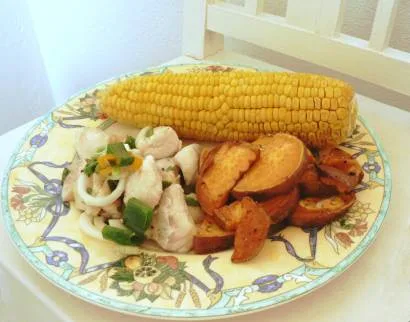
Let's hope the power stays on while I make this batch! In a ceviche, raw fish or shellfish is chemically "cooked" by citric acid, and the juice left in the bowl is what Peruvians call leche de tigre, tiger's milk. I keep mine in the fridge overnight, or for at least 8 hours. Ceviche is usually served on a lettuce leaf with a cold sweet potato and an ear of corn (or a few tasty, oversize kernels). I have since read that the oversize kernels come from choclo, an Andean corn, and that the sweetness of the potato is there to soften the sharpness of the lime. A few weeks ago I made a shortcut version of the whole plate for my husband and a friend - tasty, light, wonderful, highly recommended. Yesterday I had another ceviche for lunch at work. Somehow I managed to spill ceviche juice all over the place during my bike ride to work, so I smelled strongly of fish for the rest of the day.
Recipe card
Ecuadorian Ceviche
- Marinating in the fridge about 6 hours
You will need
| 1 lb (450 g) | white-fleshed fish (e.g. sea bass fillets) |
| 2-3 | limes, juiced |
| 2-3 | lemons, juiced |
| 2 tsp | salt |
| 1/2 tsp | black pepper |
| 25 ml (1/4 dl) | white wine vinegar |
| 1-2 | onions, sliced very thin |
| 1 | red or yellow hot pepper, deveined, deseeded and slivered |
| fresh coriander (cilantro), by the handful |
Method
- Cut the fish into bite-size pieces and place in a bowl.
- Pile the onions (and the slivered pepper and coriander) on top and pour the citrus juice all over.
- Season with salt, pepper and vinegar.
- Let rest in the fridge for about 6 hours.
Recipe card
Roasted Sweet Potato Wedges
- Oven 200 °C (400 °F)
- Baking 20-25 min
You will need
| 1 | medium-large sweet potato |
| 1-2 tbsp | olive oil |
| 1 tsp | salt |
| freshly ground black pepper |
Method
- Heat the oven to 200 °C (400 °F).
- Halve the sweet potato lengthwise, then cut each half into 7 wedges.
- Place them in a baking dish and toss with the oil, salt and pepper.
- Bake for 10-15 minutes.
- Turn the wedges over and bake for another 10 minutes, or until tender.
Recipe card
Everyday Corn on the Cob
- Microwave high, 3 min (two ears 5 min)
You will need
| 1 | ear of corn |
| a knob of butter |
Method
- Wrap the ear of corn in baking parchment (the husks can stay on).
- Microwave on high for 3 minutes (5 minutes if you make two at the same time).
- Peel and serve hot with a knob of butter.
7 comments
Hi Anna!
O, how lucky to go to Barcelona! I went last year and had such a wonderful time! I especially loved all the architecture from Gaudi and the Barri Gòtic...!
Your site looks great by the way...
I"?ve as well just started a foodblog - TastingLife.
I really hope you'll check it out sometimes!
I'm looking forward to reading more about Peruvian food on your (and your pikkuveli's) blog! I know (close to) nothing about this cuisine, though hear good things from my Peruvian aquaintances.
Hi sis, I tried the citric acid "cooking" today when I impulse bought a whole whitefish (siika for Finnish speakers). I kept the fish in the marinade for three hours, and it was to die for. Yummylicious!!!
Here is the recipe:
Lemon marinated whitefish
300 g whitefish fillet
Marinade:
3 lemons, juiced
1 tbsp apple vinegar
3 cloves of garlic, chopped
1 tbsp dried tarragon
3 tbsp granulated sugar
1 tsp salt
1/4 tsp ground black pepper
Prepare the marinade first by combining the ingredients. Cut the fish fillet into thin slices. Pour some marinade in a shallow dish, lay the fish slices evenly, pour some marinade and prinkle with salt. Lay another layer of fish and repeate. Refrigerate for ~3 hours until the fish has turned opaque.
Does it make any difference if you take the fillet from a big or a smaller fish? I've heard some people say the smaller siika are better.
Are there any "rules" for buying whitefish in Finland....? What should I be looking for? I'm a bit worried about buying Baltic Sea fish: I've read in the paper recently that the sea is really badly polluted....
Hi Penelope! Typically younger fish are tastier, but then again bigger fillets may be easier to prepare. Lately I've been cutting the fillets into nice bite size pieces instead of slicing them really thin. This way you can keep them much longer (12-24 hours) in the marinade without a fear of over cooking them.
Personally I'm not worried about the baltic fish: health officials say that it's safe to eat it in moderation (i.e. 1-2 times a week). If you're really worried, buy e.g. Norwegian salmon that grows in the Atlantic.
One fish I really like for ceviche, and which seems to be now on sale regularly, is pangasius. It comes from Vietnam where they grow it commercially. It has a really nice texture, is completely boneless, and tastes great. It sells for about €10/kg, which is a bargain compared to many local fish (go figure, it's cheaper to ship them from Vietnam than to fish them locally...)
Since ceviche is not cooked, I would follow the same rules as when making rawpickled (salted, graavi) fish: use salt water fish as freshwater fish may have parasites which may not get killed because of the lack of heat.
Thanks for mentioning pangasius. I've bought 'pangas' from Stockmann couple of times, and have been wondering what's the English name is. No I know!
Hey!
What other fish species could you use for ceviche? And is the recommended marinating time different for different fishes?