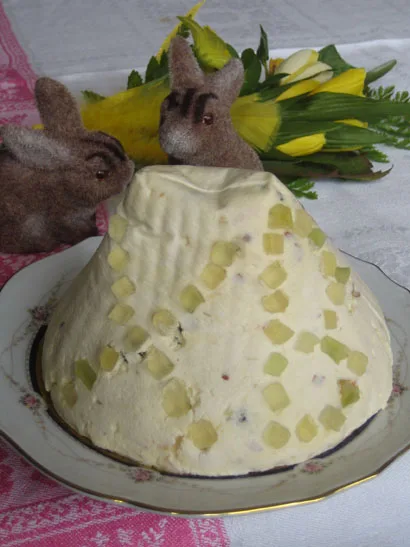
Pasha is a traditional Finnish Easter dish, especially in the eastern parts of the country. It was brought here by the Russian Orthodox Church hundreds of years ago, and it is eaten to celebrate the end of Lent. You may know pasha by a slightly different name, pascha, paskha or something similar. Pasha, or пасха, is the Russian word for Easter, and it comes originally from the Hebrew pesah. The different ways of transliterating the Cyrillic alphabet explain the small variations in the name.
Pasha is really energy-rich food, its main ingredients being quark (milk curd), cream, butter, eggs and sugar. Dairy animals produce milk fat whether you use it or not, so by the end of Lent there was a surplus of cream, and it was used to make pasha. I'm referring to the days when farming was what most people lived on, of course. So this is not light food, but once a year I can live with that, and very few of us have actually fasted for it.
Traditionally pasha is made in wooden, pyramid-shaped moulds. Since Easter is the biggest holy day of the Russian Orthodox Church, the moulds are often carved with religious symbols such as XB, short for Hristos voskrese (Христос воскресе), Christ is risen. The pyramid shape is a reminder of the Jews' slavery in Egypt.
I don't have a wooden mould, and you don't need one either. An ordinary coffee filter does the same job when it is lined with two paper filters. First the quark is drained in it overnight, and then the finished mixture is pressed into it and left in the fridge for a day. I leave the middle a little higher than the edges, because the pasha sinks as the liquid drips out. The coffee filter gives the pasha the blunt cone shape you can see in the picture, with cubes of candied lemon peel pressed into its sides. The one in the picture made it to the Easter table next to the daffodils, with two felt bunnies keeping watch behind it.
Recipe card
Pasha
- Draining the quark about 12 hours
- Draining the pasha in the fridge 24 hours
You will need
| 250 g | quark or curd cheese (in the US, look for tvorog in Russian stores) |
| 50 g | butter |
| 3 tbsp | sugar |
| 1 | egg |
| 100 ml | raisins |
| 50 ml | candied lemon peel (sukaatti, suckat) |
| 50 ml | crushed almonds |
| 3 tbsp | orange marmalade |
| 1 tsp | vanilla extract or vanilla sugar |
| 1 tbsp | lemon juice (about 1/2 lemon) |
| 200 ml | whipping cream |
Method
- Unless you use Russian tvorog, put the quark or curd cheese in a coffee filter lined with filter paper and leave it in the fridge for about 12 hours. The liquid will separate, which makes for a denser pasha.
- Beat the butter and sugar until airy and smooth. In a separate bowl, whip the cream.
- Add all the rest of the ingredients to the butter and sugar mixture and mix until smooth. Finally fold in the whipped cream carefully.
- Press the mixture into a coffee filter lined with two paper filters, leaving the middle a little higher, as the pasha sinks while it drains. Let stand in the fridge for 24 hours.
- When 100-200 ml of liquid has dripped from the pasha, tip it over onto a plate and decorate with candied lemon peel and raisins.
Kulitsa is also a Russian Easter dish, and it is often eaten with pasha. It is a sweet, buttery and incredibly tasty loaf, which is sliced like bread and topped with heaps of pasha. In Russia, I've read, kulich is baked tall and round like a cylinder, often in an old coffee tin, but this recipe makes one or two round loaves on a baking sheet, decorated with strips of dough, candied peel and raisins. The yellow tint and the smell of the dough come from saffron and cardamom. It takes only 1/8 g of saffron, so the ounce I ordered from San Francisco a year and a half ago will last a good while yet. I urge you to try this, it is absolutely delicious!
Recipe card
Kulitsa
- 1 huge loaf or 2 smaller ones
- Rising 30 min
- Oven 180 °C (355 °F)
- Baking 30 min
You will need
| 200 ml | milk |
| 25 g | fresh yeast or an equivalent amount of dry yeast |
| 1/8 g | saffron |
| 1 tbsp | cardamom |
| 1/2 tsp | salt |
| 1 | egg |
| 100 ml | sugar |
| 2 tbsp | candied lemon peel (sukaatti) |
| 100 ml | raisins |
| 50 ml | crushed almonds |
| about 700 ml | plain (all-purpose) flour |
| 125 g | butter or margarine |
Method
- Make a dough as you would for any bread or bun, and let it rise for 30 minutes.
- Shape one or two round loaves on a baking sheet covered with baking paper. Decorate with strips of dough, letters (for example XB), candied lemon peel and raisins.
- Heat the oven to 180 °C (355 °F), but don't let the loaves rise for longer than it takes for the oven to heat, otherwise they will lose their shape.
- Bake for 30 minutes.
- Serve in slices, spread thickly with pasha.
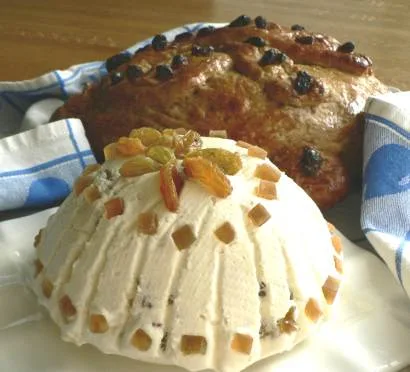
Update: This is Anna's version of the same recipe. The kulitsa is in the background, but it's really the star attraction here. Perfect for an artery-clogging Easter breakfast!
10 comments
Oh lovely, really. I especially like the added fruit, ripe for expression - think I'd do an ichthus. My Finnish family (#3 of 3) formed pasha in a clay pot lined with cheesecloth. Thanks for the inspiration, Antti!
Nice pasha, Antti, and very cute bunnies (how did you make them stand still for so long? 🙂 But no picture of the famous kulitsa!?!?!
Pille, I had serious issues with my bed this morning when I was supposed to bake the kulitsa. The bed kept wispering so beautiful words to my ear I didn't have the heart to leave the poor thing alone...
Re: the bunnies; I promised them some carrot cake later on if they posed really nice 🙂
Thanks for making pasha for all! We've had summer-like temperatures in NYC so I've been way too busy touring the neighborhoods w/ Pekka to post my pasha pics. I baked a kulitsa though so maybe I'll post that, later on.
Now I believe you:) Nice kulitsa & pasha, Anna!
Antti and Anna,
I fully support the clogging of arteries in the name of holiday celebrations.
Well done!
My auntie who grew up in St Peterburg used to make this dish every Easter. I have not eaten it since my childhood in Germany but next year I might try making it because your photos have inspired me.
Greetings from Australia, Veronika
uusi bloggi auki..
wow, I have never heard of these dishes. Thanks for posting about them, they seem wonderful.
I just wonder:
1. Is there no egg in the pasha english version?
2. No flour in the kulitsa english version?
With best regards
Sulttaani