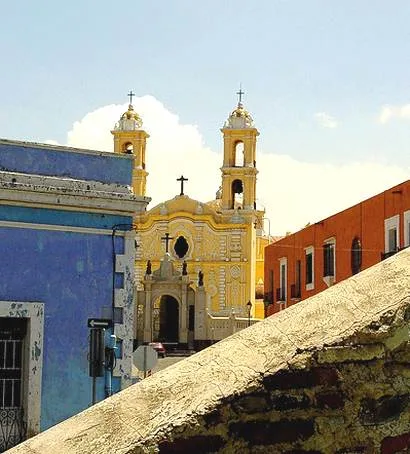
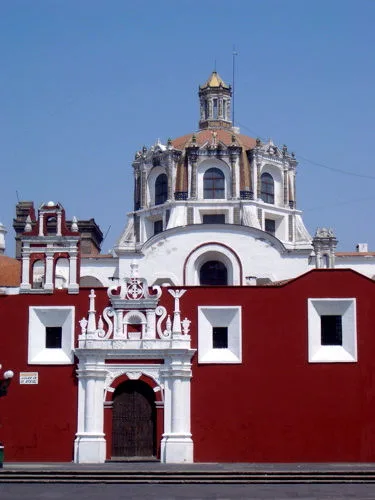
This year we spent the week around Reyes (Epiphany) in central Mexico. Of all the marvellous sights, tastes and smells, those of Puebla are lodged deepest in my limbic system. The city is terribly pretty, full of Spanish colonial buildings, but somehow more ornate and painted even brighter than other colonial cities you can find across Latin America.
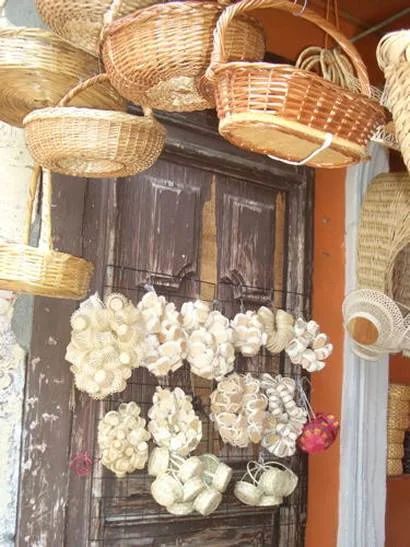
I'm not sure why Puebla felt so captivating. Perhaps it was that after a very hectic and stressful end of the year we were at complete leisure, free to spend hours in the mild winter sunshine on the Zócalo, lazily leafing through books in the dappled shade, watching lovers meet, argue, cuddle and part. The central square is a maze of trees, hedges and benches, filled with the friendly murmur of conversation. Children chased a baby pigeon, who finally took refuge in a bronze miniature model of the city, and a bum alternated between a nap and contented slugs from his bottle. We were completely mesmerised by a city-employed shoeshiner who restored a pair of badly scuffed shoes to their former glory. Ancient indigenous women carried ziplocs full of freshly carved willow whistles, and their twitter formed the soundtrack of the city, along with the splash of fountains and the blare of car horns.
We slept in a pleasantly situated former monastery, where the staff celebrated Reyes by smashing piñatas. Our room was huge, but so cold in the high-altitude midwinter that we had to wear extra layers of clothes to bed. It never gets this cold indoors in Finland 😉 Even this feels somewhat satisfying in retrospect, one of the many surprising contrasts Mexico had in store for us.
The biggest surprise of the trip was Mexican food. Somehow, the stuff that goes by that name in US restaurants is frequently bland, Anglicised and of inferior quality, limp nachos, rock-hard taco shells and dubious dishes smothered in sour cream and shredded lettuce. (I ate much more of this than I really care to remember while travelling in Texas.) What I encountered during my brief stay in Mexico bore little resemblance to my preconceived idea of Mexican food. I found an ancient, complex and original cuisine, completely on a par with France or Italy, but much harder to fathom. Do I understand beurre manié, soufflés and risotti? Yes, to some degree. But can I confidently balance three different types of chillies in a dish? Or soak, grind, knead and shape corn into a perfect tortilla?
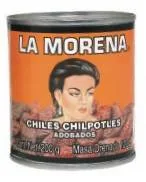
Right now I'm taking my first baby steps towards understanding the Mexican kitchen a bit better, to recreate some of my favourite antojitos, the little snacks, but also to re-experience the smoky, deep stews and hearty, flavour-packed soups that so surprised me. A decent basic cookbook should be in the post; while waiting for it, I'm toying with chipotles (in this I have unexpectedly been inspired by a Swedish fellow food blogger). Here, paraphrased, is an article on chowbaby.com that gives every novice the basics about chipotles.
Dried or canned, chipotles, which are ripened, smoke-dried jalapeño peppers, have the magical capacity to turn an ordinary cook into a talented chef. Chipotles pack a sharp burn, but their subtle, complex flavour becomes apparent once you have adapted to the heat. Most supermarkets and corner groceries now stock canned chipotles, usually in a rich, dark, spicy garlic and tomato sauce called adobo. Canned chipotles are dark reddish-brown and high in sodium. The peppers slice very nicely with a knife, or you can tip the entire contents of a can into your blender or food processor and purée it for a delicious sauce. Specialty stores sell dried chipotles, which are lighter in colour and give off an aroma faintly reminiscent of cigarettes. Before using them, remove the seeds and devein them. Then toast them gently in a hot dry skillet to release their volatile oils, and cover them with hot water for a few minutes until they soften and plump up. Throw away the steeping liquid, which can become bitter. Either way, you will usually want to balance chipotle's diabolical heat with a hint of something sweet, honey, sugar, fruit juice or the like.
chowbaby.com

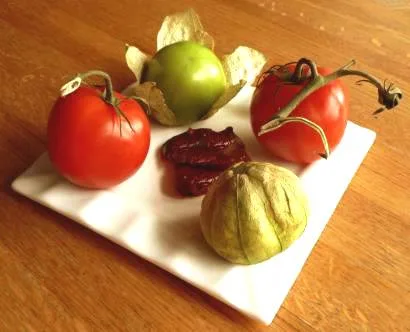
My Spanish is very rudimentary, based on a long-forgotten intensive spell of learning in secondary school. New York is a highly bilingual city, however. At work the secretarial staff are all Spanish-speaking, so I can hone my comprehension by listening in on the local gossip. The Spanish TV channels are still almost too challenging for me, but a while back the game show "100 Mexicanos Dijeron", where families compete to name the most widely used words, expressions and colloquialisms of their local dialect, taught me the word albóndiga, a concept very near to the heart of all Finns and Swedes, the meatball. So tonight it is going to be meatballs in chipotle salsa.
Recipe card
Albóndigas en Salsa de Chipotle
- about 20 small meatballs
- Roasting the tomatoes about 10 min
- Sautéing about 8 min
- Frying about 10 min, in two batches
You will need
For the meatballs
| 1 | tomato, pan-roasted until blistered, deeply browned and soft, then chopped |
| 1 | onion, finely chopped |
| 2 | cloves of garlic, minced |
| 0.5 tsp | ground cinnamon |
| 0.5 tsp | dried oregano |
| 0.25 tsp | freshly ground black pepper |
| 0.25 tsp | ground allspice |
| 2 tbsp | chopped green olives |
| 2 tbsp | golden raisins |
| 1 tbsp | drained capers, chopped |
| 1 tbsp | olive or canola oil |
| 250 g | ground beef |
| 250 g | ground pork |
| 1-3 | slices of white bread, crumbled |
| 1 | egg |
| 0.75 tsp | salt |
| finely ground breadcrumbs, coarse cornmeal or plain flour, for rolling |
For the salsa
| 2 | tomatillos or tomatoes, pan-roasted until blistered, deeply browned and soft, then chopped very finely |
| 2 | chipotles in adobo, deseeded, or dried chipotles, deseeded, deveined, toasted and soaked in hot water |
| 2 | roasted cloves of garlic (oven-roasted, or roasted in a frying pan, turning often, for about 15 min) |
| 0.5 tsp | salt |
Method
- Roast the tomatoes and tomatillos in a dry pan, turning them over and over, for about 10 minutes until softened and blistered all over. Set aside those for the salsa; chop the one for the meatballs.
- Mix the chopped tomato with the onion, garlic, all the spices, olives, raisins and capers, and sauté in the oil for about 8 minutes or until softened. Let cool.
- Combine with the ground meat, crumbled bread, salt and egg. Do not use sirloin ground beef; higher-fat ground beef and pork make much better meatballs, and a 75-25 or 50-50 beef-pork ratio is ideal.
- If the mixture is too soft for rolling, add a bit more crumbled bread and mix thoroughly.
- Cover a cutting board with finely ground breadcrumbs (coarse cornmeal or ordinary plain flour also work) and roll small meatballs 2.5 cm (1 in) across.
- Fry them in two batches in a very lightly oiled non-stick pan for about 10 minutes, shaking or turning frequently.
- Meanwhile, put all the salsa ingredients in a blender or use an immersion blender. I have neither here in New York, but I found that chopping the tomatoes or tomatillos, chipotles and garlic very finely with a sharp knife makes a pleasantly chunky salsa.
- Remove the seeds from the chipotles first; for me it makes all the difference between pleasurably fiery and intolerably painful. You can always add the seeds back for extra heat. Depending on your chipotles, you may need more or less salt than I did.
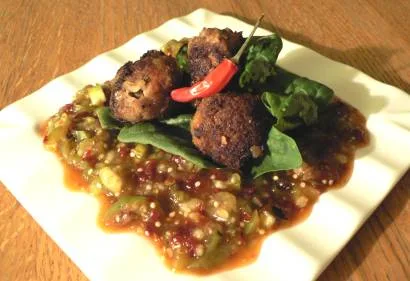
The meatballs turned out light and crispy, but the real star was the chipotle salsa, which I used as a dipping sauce. I had never cooked with tomatillos before, the sour, green, sticky, tomato-like fruits with husks around them. The fieriness and tartness of the salsa were just right.
I found tomatillos in the first supermarket I checked here in northern Manhattan; any area with a Mexican presence is a pretty sure bet. However, the bored-looking Puerto Rican checkout girl at Met Foods acted as if she had never seen the fruit before either. "Wha's that," she intoned, and drew a blank at my reply.
In Puebla this salsa is commonly made with ordinary tomatoes, so don't hesitate to make the substitution if you can't find tomatillos. The meatballs would work well as party food. If serving them as a main course, I'd make a green salad or grill a few slices of polenta on the side (fusion-y, but serving anything corn-based is hardly wrong with Mexican food).
4 comments
Wow, that recipe sure looks worth trying, if I ever manage to find chipotles! My only experiment with Mexican food has so far been some kind of picadillo stew. It was quite good, though...
Pagisija: You can order locally (Finland) grown and smoked chipotle powder from Fatalii (http://juuri.org/fatalii/). It's apparently super high grade, and raved all over the Finnish chile scene :o)
Your post brought back lots of nice memories, including some fab albóndigas when I was in Mexico in September! I stayed mostly in Mexico City (only wondered out to Tepostlan and Guernavaca), but I had some wonderful food. I stayed with a friend who used to work as a chef before having kids, and her husband is very much into good food, so we ate in lots of great restaurants - plus great home cooking - during my 10-day stay. Can't wait to get back there!
And as Pagisija said, this recipe sure looks worth trying!
Mexico City was wonderful. I wouldn't mind living there. The food... oh c'mon, I'm getting hungry just thinking about it. Someone has let out the secret though, because the city was packed with Finnish tourists. We saw Finns and heard Finnish every day. I've seen that many fellow Finns only in places like Tallinn and Stockholm...