If duck breast is on a restaurant menu, it is likely to be on my plate before long. Many people steer clear of duck for no good reason, imagining that it is somehow especially hard to cook. In my experience a duck breast fries just like any other piece of good meat. The important thing is to have the patience to marinate it for long enough, a full day for preference or at least overnight. A duck, like a cow, does not care to be killed twice, so the middle must stay good and red for the best result. The juicy, aromatic meat really does suffer from overcooking and, worst of all, loses its tenderness.
The inspiration for this dish came from the Thai volume of the splendid What's Cooking series (splendid less for its recipes, perhaps, than for the way it looks). The cookbook was still lying open on the table when the food was on the plate. This is not really a Thai recipe, though. The chilli, lime and soy only bring a hint of the Asian kitchen, so it will also do nicely for those who do not otherwise care for Thai food.
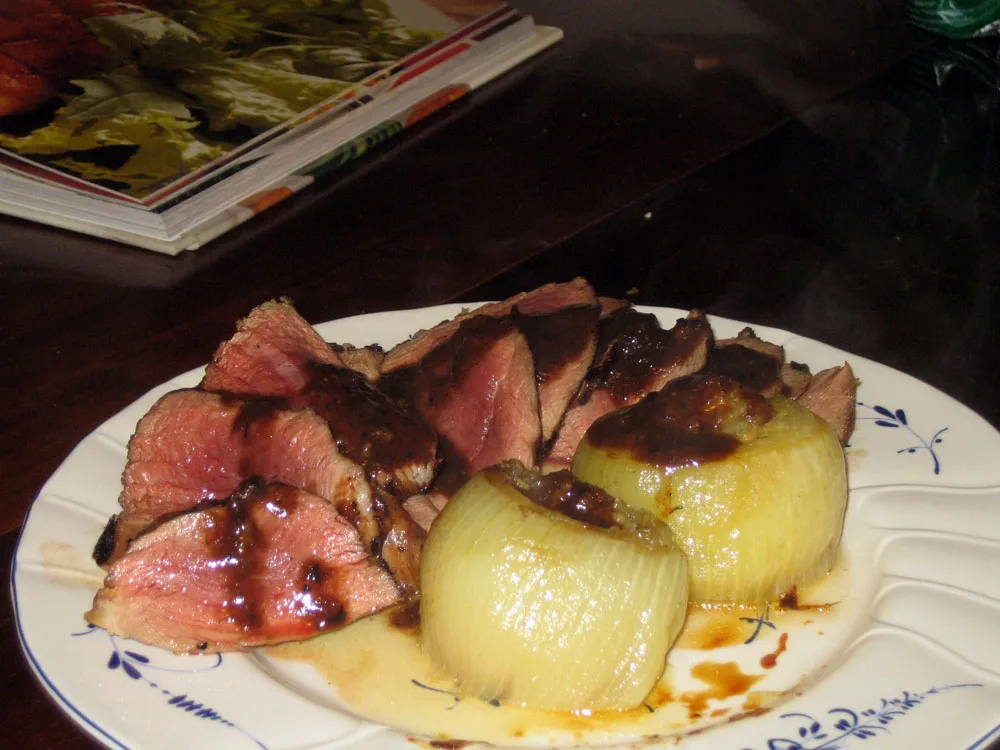
The marinade is made of crushed garlic, palm sugar, lime juice, soy sauce and chilli. Palm sugar is sugar boiled down from the sap of palm trees, but dark cane sugar will do as well. I put the breasts and the marinade in a freezer bag, because there even a small amount is enough to coat them all over. Before that I score the skin criss-cross a good centimetre apart, deep enough to reach the fat but not the meat. Through the cuts the fat melts out into the pan, and there is so much of it that no other fat is needed. I take the breasts out of the fridge in good time to warm up, so that the middle does not stay cold during the short frying. I fry the skin side first, and the heat has to be watched so that the skin does not burn black. The slices in the picture have a narrow brown band at the edge and are red in the middle.
The marinade does not go to waste, because I keep it and pour it into the pan at the end, where with plum jam and chicken stock it becomes the sauce. Only a tablespoon of jam goes into it. Duck and plum sauce are a familiar pair from Chinese cooking. There is time to boil the sauce down to the right thickness while the breasts rest on the chopping board for ten minutes or so.
Jasmine rice would make a fine accompaniment as well, but I wanted to keep the calories in check, so the rice had to make way for juicy baked onions. Onions are among my favourite ingredients in any case. A hollow big enough for a thumb is scooped out of the top of each onion with a teaspoon, and a stock cube is pressed into the bottom of it. On top go a knob of butter, a dash of balsamic vinegar and some herbs, and the piece that was scooped out is put back as a hat. Wrapped in foil the onions bake in three quarters of an hour until they are so soft that they have to be lifted onto the plate with a big spoon. They stay upright there all the same, since a slice has been cut off both ends.
Recipe card
Duck Breast and Baked Onions with Plum Sauce
- serves two
- Marinating at least 3 hours, preferably overnight
- Oven 175 °C
- Baking the onions 45 min
- Frying the duck 4-5 min + 2-3 min
- Resting about 10 min
You will need
| duck breast fillets |
Marinade
| 1-2 | cloves of garlic, crushed |
| 2 tsp | palm sugar or dark cane sugar |
| 1 1/2 tbsp | lime juice |
| 1/2 tbsp | soy sauce |
| 1/2-1 tsp | chilli sauce, or the equivalent amount of fresh chilli |
Sauce
| 1 tbsp | plum jam |
| 50-100 ml | chicken stock, real or made from a cube |
| salt and pepper |
Baked onions
| 1-2 | large onions per person |
| 1 | beef stock cube per onion |
| butter | |
| balsamic vinegar | |
| herbs (thyme, tarragon, rosemary, marjoram etc.) |
Method
- With a sharp knife, cut criss-cross slashes in the skin of the duck at intervals of a good centimetre, so that they form a neat diamond pattern. The cuts should go well into the fat, but take care not to damage the meat itself.
- Mix the crushed garlic, palm sugar, lime juice, soy sauce and chilli together. Put the duck breasts in a freezer bag, pour the marinade over them and mix thoroughly. Leave in the fridge to marinate for at least three hours, preferably overnight.
- Set the oven to heat to 175 °C about an hour before you plan to eat. Peel the onions and cut a slice off the top and bottom of each, so that they stay upright in the oven and on the plate. Scoop a thumb-sized hollow out of the top, with a teaspoon for instance. Prick holes in the bottom of the hollow with a fork to help the seasoning into the onion in the oven. Take care, though, not to pierce the outermost layer of the onion.
- Press a stock cube into the bottom of each hollow, smear a knob of butter on top of it, add a dash of balsamic vinegar and sprinkle in the herbs of your choice. Finally cover the hollow with the "hat" left over from the scooping. Wrap the onions one by one in foil and bake for 45 minutes, or until they are completely soft.
- Duck breasts need no extra fat for frying. In that respect they are entirely self-sufficient. Even if you do not eat the skin, it is worth frying the breasts with it on. Take them out of the fridge to warm up in good time before frying.
- Heat a frying pan until it is very hot, and meanwhile wipe the marinade off the duck breasts. Keep the marinade. Fry skin side down first for 4-5 minutes. Watch the temperature of the pan and lower it if necessary, as the skin must not burn black. Pour off the fat that has melted into the pan and turn the breasts over. Fry for 2-3 minutes, until the surface is nicely browned.
- Add the reserved marinade, the plum jam and the chicken stock to the pan. Let it simmer for a couple of minutes more. Lift the duck breasts onto a chopping board and leave them to rest for ten minutes or so. If the sauce is too runny, go on boiling it down until it is right.
- Take the onions carefully out of the foil. They are now very soft and juicy. A big spoon helps in lifting them. Cut the duck breasts on the slant into thin slices, arrange them on the plate beside the onions and drizzle with the plum sauce.
Although duck skin is a great delicacy of mine, I have lately, with a bleeding heart, been cutting it off after frying, before slicing. Duck meat is lean in itself, but the thick layer of fat under the skin easily doubles the energy content of the serving.