Finns have a dreadful habit of poisoning their foreign guests with too much fish. I plead guilty first. When friends from abroad visit Helsinki, I drag them without exception to places whose menus are shoaling with salmon, arctic char and trout, and we stuff them to the gills with herring besides. Even for a casual meal I recommend Sikala, Salve and the dining room at Botta, where Baltic herring is hard to avoid.
Night after night these dinners accumulate in the system, and by the time they leave, our visitors have grown fins from an overdose of vitamin D. No wonder they quickly form the impression that Finns eat nothing but fish. Friends around the world take it for granted that I keep an Arctic diet at home too.
This is wildly incorrect, although Finland does have over 1,000 kilometres of seaside and 190,000 lakes. When I was growing up, fish was considered the poor cousin of meat. I think it still remains the cheapest source of animal protein for Finns. These days supermarket specials regularly feature domestic farmed rainbow trout and Norwegian salmon.
In truth I cook fish at home far too seldom. I dread fish guts fermenting in the organic waste bin, gunky sheets of foil, salmon fat on the floor of the oven and the reek of fried herring working its way into the sofa. For comfort's sake I favour two methods that keep smell and mess to a minimum: steaming and curing.
Today's entry is of course gravlax, with a twist. The name is Swedish and means buried salmon. A little searching online turned up that in the Middle Ages fishermen really did bury their salted salmon in the beach sand, where it soured a little. These days, thankfully, it is enough to put the fish in the fridge for a couple of days with salt, sugar and dill. Gravlax sounds intimidating, but it is one of the easiest dishes I know. I throw the seasonings into the package the moment I come home from the shop. It takes two minutes or so. The curing takes about two days, so you have to plan ahead a bit, but the result is delicious.
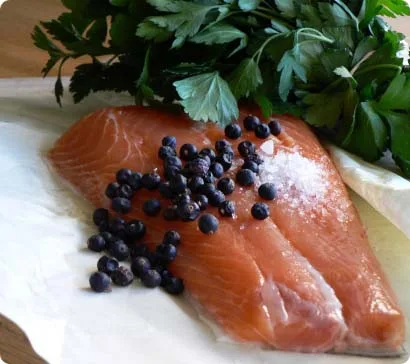
Traditional gravlax is a fine thing, of course, but I am very attached to this slightly more modern recipe. It has no dill and no sugar, and it borrows the favourite flavour of the ski jumper Matti Nykänen - it all began with lonkero, the Finnish gin long drink, didn't it? Gin is juniper spirit, after all, and juniper berries and salmon are a match made in heaven. Gin salmon is so easy that even the former eagle of the ski jump would surely manage it.
Juniper berries grow on the bush at the far end of the pasture, but good shops also keep them dried on the spice shelf, next to the cinnamon. Dried ones are fine. To a botanist they are cones, small and fleshy. If you pick your own, leave the green ones on the bush to ripen and take only the blue-black. I grind them in a small electric coffee grinder consecrated to spices, but a mortar or plain finger power will do too.
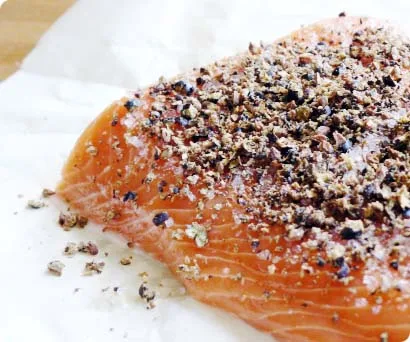
When I open the package two days later, a spoonful of brine has gathered at the bottom. The flesh is firmer and a little darker than when it came from the shop.
Recipe card
Gin-marinated Gravlax
- Curing about 2 days
You will need
| about 500-700 g | the tail end of a fillet of salmon |
| 2 tbsp | crushed juniper berries (dried are fine) |
| 2 tbsp | kosher salt |
| 3 tbsp | gin |
Method
- Unwrap the supermarket package the salmon came in.
- Crush or grind the juniper berries (I use a small electric coffee grinder kept for spices, but a mortar or plain finger power will do as well).
- Sprinkle the crushed berries on the fleshy side of the fillet, sprinkle with the salt and slosh on the gin.
- Rewrap the package, put it in a plastic bag and store it at the bottom of the fridge. I sometimes add a weight on top.
- Try to remember to turn the package once or twice.
- After about two days (48 hours) the fish should be cured. It keeps for a few days.
- Slice very thin with a sharp knife. I usually serve it either as a starter or as a light meal, on its own or with a tossed green salad.
So please bear with us, because salmon is going to feature regularly on these pages.