Homer: "See Marge, they could deep-fry my shirt." Marge: "I didn't say they couldn't. I said you shouldn't."
The Simpsons
Marge is wise to steer clear of the unknown, but her wisdom doesn't quite apply to my new love, steaming. With a steamer it pays to try something you have never steamed before. Besides, frying pretty much destroys any and all flavour of the ingredients.
I bought my Chinese bamboo steamer years ago, while strolling the kitchenware aisles of my local Target in Boston. I had recently come back from Hong Kong, where bamboo steamers were everywhere I looked, and so the ones on the shelf caught my eye. The price was less than $20, and I bought one on a whim. Back home I found that it was too big to fit into any of my pots or pans. Too lazy to return it, I shoved the box on top of the kitchen cupboards, and it has gone unused ever since. Last week that changed.
I happened to buy heaps of bok choy and green beans from a nearby Asian market, and at the same time Anna was telling me about her steaming experiments in New York. I remembered my ill-fated steamer, dug it out of a closet and re-read the instruction leaflet. Then it dawned on me. Steam is hot. Heat goes up. Ha! I could simply place the steamer on top of a big pot instead of trying to fit it inside one. It works like a charm. (And no worries about setting the steamer on fire, sis.)
Chinese buns, dumplings, dim sum, whatever the name, are often steamed. When people in Finland think of Chinese food, stir-frying is most likely the first thing that comes to mind. Before I started travelling in South East Asia I too associated Chinese cooking with woks that dripped with fat and looked really unhealthy. Now I know that there are tons of steamed dishes that are literally fat free, meaning that no fat is added to them at all.
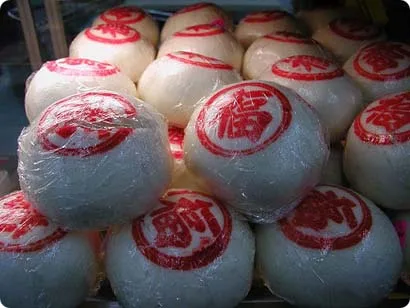
The buns in the picture are filled with lotus paste, a sweet paste made from lotus seeds. Many varieties of similar buns, ready to be steamed, can be bought at an Asian market near you. Frozen buns make a tasty side dish for any Asian meal. 10-15 minutes in a steamer, and voilà.
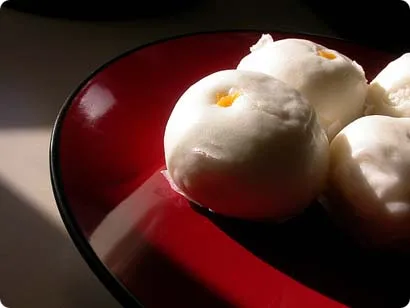
The beauty of steaming is its speed and versatility. While a few buns are heating, the main course cooks in the same bamboo tower. It is also a very quick way to prepare food, almost comparable to a microwave oven. A hearty fillet of fish is ready in six minutes, vegetables included.
Let's have a look at this big fellow I bought yesterday. I asked for half a salmon, and that is exactly what I got, head and all.
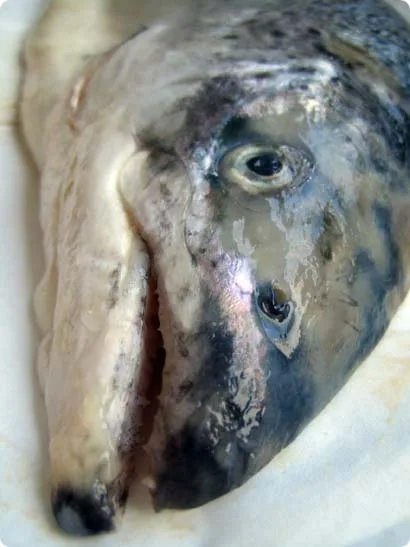
Until now I have always either pan-fried fish or baked it in the oven. This time I filleted the poor salmon, butterflied some of it, whipped up a quick Thai marinade, rinsed a heap of bok choy and put everything in the bamboo steamer. It is a good idea to put fish and other potentially smelly things on a plate to protect the steamer.
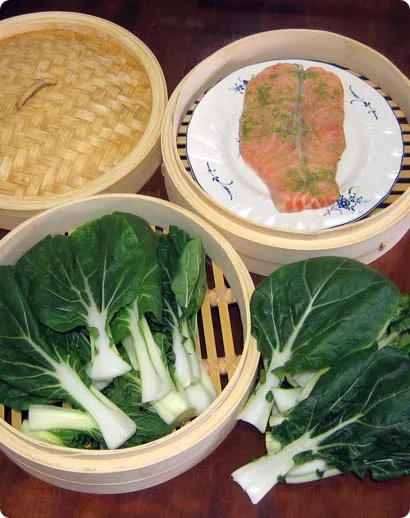
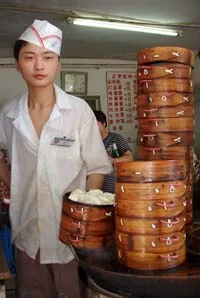
For those who have not seen or used a bamboo steamer before, the baskets are piled on top of each other into a tower, so only one source of steam is needed. The tower stands on a pot of boiling water for six minutes, and the meal is ready. That's what I call fast food!
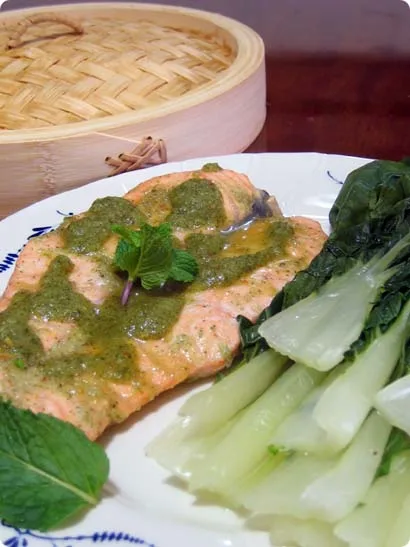
Recipe card
Salmon in Thai Sauce
- Serves 2
- Marinating 20-30 min
- Steaming 6 min
- Energy 480 kcal / serving
You will need
| 1 bunch | fresh coriander, with stems and roots |
| 12 | mint leaves |
| 1 tsp | chopped fresh ginger |
| 3 | cloves of garlic |
| 1 tsp | salt |
| 1 | large red chilli, finely chopped (or dried chilli) |
| 2 | limes |
| 1 tbsp | nam pla (fish sauce) |
| 2 x 200 g (7 oz) | Norwegian salmon fillets |
| plenty of bok choy |
Method
- Blend the coriander, mint, ginger, garlic, salt, chilli, the juice of the limes and the nam pla in a food processor to a smooth paste.
- Use two thirds of the sauce to marinate the fish for 20-30 minutes.
- Place the bok choy and the salmon fillets on a plate in a steamer and steam for six minutes.
- Pour the reserved sauce over the fish and serve immediately.
12 comments
Voitko kertoo mistä Helsingistä saa lootuspullia?
Vii Voanista (ylläri). Aseanic Tradingissa on ziljoonaa muuta kiinapullasorttia, mutta lotukset siellä taisivat olla lopussa. Vii Voanissa oli sekä lotus pastella että lotus seedeillä tehtyj
Hey, thanks for visiting my blog and your kind comment! I luuurve steaming and I use my bambo steamer all the time. And talk about food porn, when I saw the photo of the lianrong bao, I went "Oooohh!" ... sad.
Great site!
Thanks for your comment! I saw referrals from your site and was like "WHOA WHAT LANGUAGE IS THIS?" ;D I wish I could read more of your blog, hehe. Dammit, why do I only know English?
Toodles
Robyn
MM, thanks for visiting too 🙂 You live in Singapore, I guess? I wish I could spend more time in SE-Asia, I'm totally in love with the food there! I visited Singapore last December, and had very good Chili Crabs there. Yummy!
Hi Antti and Anna!
Wohooo, a post in English, how great!!!Although I was about telling you that one of my kind readers offered to do some translation for you into Finnish:) (she is a finnish translator)see the commentbox of the avocado post.
This post is great, in fact, I was inspired by Andreea at Glorious Food and Wine and then your post about Cambodian food to buy a bammboo steamer. I already tried it, I think it will be a new favorite!
Uh, but that salmon looks scary:)
Zsofi
Hi Zsofi,
Wonderful and very helpful, I will definitely ask Eszter for some translations, your site has so many fabulous recipes. Food blogs are such an amazing thing - in Finland, I have a tiny Gundel's cookbook from Budapest, but it is much more fun to learn what people actually eat at home. And your pics are simply mouthwatering.
We wish you many creative moments with your bamboo steamer! I know Antti and I are completely bonkers, but fish prepared in a steamer is a revelation - the flavors are locked in the fish, and the texture of the fish becomes undescribably delicious. Just check often - 5 to 6 minutes goes a long way (10 for really thick cuts); overcooking will ruin the fish. And watch out for burns! Steam is almost invisible and seems so innocuous - but it is actually very hot, and always end up burning my fingers 😉
Hei Anna,
Oli ihanaa löytää taikinapojan ja lukea suomeksi ruoka-asioista. Ja vielä ihanampaa, että kirjoitat niin lämpimästi Unkarista ja Budapestistä. Kyllä suomalaisten vieraittemme määrästä päätellen Unkari sijoittuu hyvin suosittujen kaupunkien listalla. (Ja toisena tekijänä varmasti vaikuttavat suomalaisittain edulliset hinnat.)
Niin, resepttikäännöspalvelun tarjous on voimassa, kysy vaan jos olet Zsofin blogissa löytänyt jotain kiinnostavaa. Hän postaa (onkohan se oikea verbi?) joitakin unkarilaisia resepttejä myös englanniksi juuri sinunlaisia lukijoita varten. Tykkään hänen lähestymistavastaan unkarilaisiin klassikkoihin, tarvitsisimme juuri sellaisen visionäärin, joka nostaisi unkarilaisen keittiön takaisin vanhaan loistoonsa. Syventymättä tähän hyvin vaativaan aiheeseen ja säästäen sinua siitä lähetän terveisiä, Eszter
Hei Eszter,
Mahtavaa kun löysit blogimme - suomesi on fantastista! Sinun pitäisi oikeastaan ruveta bloggaamaan meidän saitillemme - paranisi kirjallisen ilmaisun taso kertaheitolla 😉 Joskus vielä haluan opetella unkaria... teilläpäin reissatessa yksittäiset sanat tarttuivat nopeasti korvaan, kun kielen nuotti on niin tuttu, mutta eiväthän sana päässä pysy jollei saa jatkuvaa kielikylvetystä. Budapest on mielestäni kosmopoliittinen tavalla jota Helsinki vasta hapuilee, muusta Suomesta puhumattakaan. Mutta nythän me jo olemme samaa valtakuntaa...
Velipoika joka on rantautunut Bostonista Suomen leveyksille haluaa mieluiten blogata englanniksi, mutta koska olen toistaiseksi ulkosuomalainen, aion postailla omaksi ilokseni edelleen myös suomeksi. Suomenkieliset juttuni ovat vastedes piilossa viestin lopussa, jos haluat niitä lukea. Lämpimät terveiset!
Anna
Oi mikä blogi, löysin tänne tänään (olen juuttunut jo aika pitkäksi aikaa...) Hienoja kuvia ja todella mielenkiintoista luettavaa!
Sitten käynkin suoraan ruoka-asiaan: oletteko testanneet ihan tavallista höyrytyskattilaa, ja onko tuo bambuhöyryhässäkkä paljonkin parempi? Olen myöskin innostunut höyryttämisestä, ja mietin tietysti lisähankintoja 🙂
Hei Sanna! En ole kokeillut höyrytyskattilaa, joskin en ymmärrä miksei ne toimisi yhtä hyvin kuin bambuinen. Ainoa ero voi olla se, että bambuhöyryttimen kansi päästää höyryn lävitseen, eli vesi ei pääse tiivistymään kanteen ja valumaan takaisin ruuan päälle. Lisäksi bambuinen on niin kivan näköinen että se tuo mukavan lisäsäväyksen keittiöön, ja siinä ruuan kehtaa kantaa vaikka pöytään asti.
Sanna,
Olin juuri pistäytymässä Hong Kongissa ja siellä dim sum -ravintoloissa tuotiin höyrytetyt nyytit ja pullat pöytään söpöissä pikku bambuhöyryttimissä.
Mulla on itse asiassa kaksi bambuista höyrytystornia, pienempi erilaisille nyyteille ja isokokoinen bambuhöyrytin joka vetäisee kokonaisen lautasen sisäänsä taas kalalle ja sen vihanneslisukkeille (lautasta käyttämällä höyrytin pysyy).
Olemme aivan hulluna esim. teriyakimaustettuun höyrytettyyn lohifileeseen. Antti antaa teriyaki-kastikkeen reseptin toisaalla blogissa, marinoi siinä 1-2 lohifileen puolikasta puoli tuntia ja höyrytä sitten 6-8 min. Höyryttäminen antaa kalalle aivan uskomattoman tekstuurin, mikään osa kalasta ei mene hukkaan, ja tiskiä säästyy.
Anna