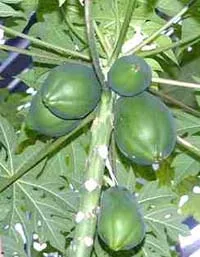

Right at the top of the meals I ate last year comes a dinner at the Phnom Penh restaurant in Vancouver. It is a modest-looking, inexpensive Cambodian family place squeezed between the tiny Chinatown and the Downtown Eastside, the final dumping ground for the city's junkie wrecks. The green papaya salad and the crab stew stopped the conversation dead and left us wondering when we had last put anything so good in our mouths. The city was a tremendous food experience altogether. Its uncompromising devotion to fresh, tasty ingredients, its big Asian community with its food, and the extraordinary beauty of the Pacific and the snow-capped mountains would in fact tempt me back for a longer visit. As first aid for the travel bug we have already been to see a daft Bollywood film shot in Vancouver, Neal 'n' Nikki.
In the past twenty-four hours New York has had 24 inches (60 cm) of snow dumped on it, a record for 150 years. On our street the bonnets of the cars are under the drifts, the airports are shut and the city is eerily quiet, but indoors the mood is warm and tropical, because yesterday I fetched enough food for a week from a sleety Chinatown. The main quarry of the hunt was green papaya, which after a little searching turned up at the fruit stand of the Kowloon Bay market on the Bowery (whose near-extinct bums brought back a whiff of Vancouver). I planned an Indochinese meal around the papaya, which had the bamboo steamer tower I bought last week from a restaurant supplier round the same corner wobbling on my stove again.
When we travelled in Brazil some five years ago, a halved ripe orange papaya seemed to be the whole country's breakfast favourite. I have never really warmed to the fruit, and still less to its juice, which tastes of stale aftershave. Green papaya is another thing altogether. The generic taste and texture of the unripe fruit are startlingly close to raw swede or turnip. (If anyone feels like fusion-cooking this meal with swede or turnip - Pille, I'm thinking of you - I promise in return to try a mango and papaya bake in place of the swede casserole next Christmas.)
The inspiration for the meal is of course the film classic The Scent of Green Papaya, which teaches you everything essential about this vegetable. Tran Anh Hung's first feature is about a servant girl in 1950s Saigon, and apparently the whole of Saigon was built in a studio in Paris.
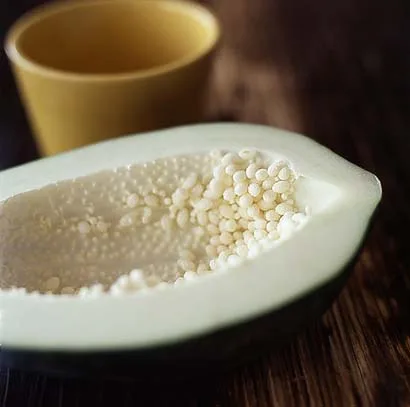
I adapted the salad from this original recipe and made the fish following a recipe in English. I scraped the colourless seed pods out of the papaya and grated the flesh, then poured a sweet fish-sauce dressing over it. Sticky rice (sticky rice, glutinous rice, sweet rice) has to soak for at least four hours, so the meal takes a little forethought. The rice cooks in the lower basket, and the fish goes above it in a basket of its own only for the last few minutes.
Recipe card
Green Papaya Salad
- Standing a while in the cold
You will need
| half | a green papaya (or 1 swede or turnip) |
| a handful | of fresh mint |
Sweet fish-sauce dressing
| 25 ml | hot water |
| 25 ml | sugar |
| 1 | lime, juice only |
| 35 ml | nam pla (fish sauce) |
| 3 | small Thai chillies, in thin rings (seeds removed) |
Method
- Peel and halve the papaya. Scrape out the funny colourless seed pods with a spoon and throw them away.
- Grate the flesh coarsely or cut it into julienne sticks.
- Mix the dressing and pour it over the papaya.
- Leave to stand and take on the flavours for a while in the cold before serving.
Recipe card
Steamed Thai Fish with Sticky Rice
- Soaking the rice at least 4 hours
- Steaming the rice 20 min
- Steaming the fish 5-10 min
You will need
| about 100-200 ml | sticky rice per eater (a steamer basket holds 500 ml at most) |
| 1 | fish fillet with skin per eater (salmon, cod, catfish, red snapper...) |
For each fillet
| 1 tbsp | sake |
| 1/2 tsp | salt |
| 2.5 cm | fresh ginger |
| 1 | small Thai chilli |
| 1 | spring onion |
| sesame oil |
Method
- Soak the sticky rice in water for at least four hours.
- Drain the rice in a sieve, line the lower steamer basket with baking paper and spread the rice in it in an even layer. Close the lid of the steamer tower and steam for 20 minutes.
- Mix the sake and salt and marinate the fillet in it.
- Soften the peeled, finely chopped ginger with the chilli and the white part of the spring onion in hot sesame oil for just under a minute.
- Lift the fillet onto baking paper in a basket of its own, above the rice basket. Scatter the chilli, onion and ginger mixture over the fish.
- Steam for 5-10 minutes, depending on the size of the fillet. Meanwhile the rice goes on cooking in the lower basket. Add the green part of the spring onion for the last minute of steaming.
- Serve the whole spread with the papaya salad.
9 comments
Hitsi kun ei oo höyrytyskoria 🙁
Höyryttäminen on DA kypsennysmuoto. Mulla on tuossa just lohimedaljonki thaimarinadissa ja kasa vauvabokchoytä odottamassa höyrysaunaan pääsemistä 🙂 Nams!
Luulis että tollainen korisysteemi löytyy ihan tavaratalosta, tyyliin Stockalta - tai sitten jostain pingpong-kaupasta. Sticky riceä oon ainakin ostanut 1990-luvulla Helsingissä ja kai sille jostain joku kypsytin pitäis löytyä. Kun tuun käymään Suomessa maaliskuussa mulle tulee serious issues tullin kanssa - tekee mieli raahata mukana niin paljon kaikkea kivaa.
Mulla on Suomessa ollut iät ja ajat sellainen 1970-luvun kotitalousopejen suosittama perunahöyrytyslävikkö ("arvokkaat vitamiinit talteen etteivät mene keitinveden mukana hukkaan"), mut ei se oo yhtään kiva - varsinkin kun se yleensä räpsähtää kriittisellä hetkellä kokoon. Tuleen syttyvä bambukehikko synnyttää sitä paitsi paljon paremmat lieskaefektit - palohälytin oli eilisen irtiruuvattuna...
I'm far from being a "fusionist", but who knows, I might go and get some "lanttua tai naurista" and give your recipe a go:)
Pille, I was tickled to death by "Polish-Mexican" and bortsch noodles... Both sound like crazy, fun cultural collisions, like expat food bloggers, sort of 😉
What I do not like is the nonsense fusion food that used to be so prevalent in restaurants some years ago, wholly based on unhappy marriages of ingredients that were never intended for each other. In Helsinki, this trend just won't go away. Every time I visit, food still arrives piled in a tower, inevitably garnished with pea shoots. Death to scallops with fresh strawberries and vanilla sauce!
Oh, what a shame we don't understand eachothers languages!!I think you are writing about some cambodian food? I'm going there in April, I would love to read your post. But it's good that you have put the links to the English recipes:)
Zsofi
Zsofi,
Anna and I are trying to figure out the best way to phase Doughboy into a bi-lingual blog... Shouldn't take too long I hope.
A few weeks ago in New Zealand I met some people who were raving about Cambodia as an unspoilt travel destination. Please do share your experiences in English also when you come back 🙂
Zsofi, I've never been to Cambodia, although I'm dying to go whenever I move to a time zone that is just a little bit closer. Last summer, we happened to find a Cambodian family restaurant in Vancouver, BC. The place didn't look like anything special, and it's located in the dodgier parts of the city, but there was a line of about six people, and a young Cambodian-Canadian customer told us that the place was well worth a wait, so we lingered on.
Khmer food was new to us but stunning in its simplicity and packed with flavor - one of my best dining experiences last year. I loved the simplicity and harmony of the flavors. Their green papaya salad was delectable, accompanied by some sort of crab dish.
I live in Manhattan, so I finally took the time to look for green papayas in Chinatown. I found one for less than $2 in a vegetable stall on Bowery. When grated or julienned, it tastes quite a lot like raw turnip - a taste that is a lot more familiar to Northern Europeans than papaya... This recipe was a nice try but I still quite haven't figured out how to recreate the salad I ate in Vancouver. Anyway, I'm sure you are going to encounter some truly wonderful food on your trip - happy tasting!
Oi miten herkullisia sivuja!
Ja todella korkealaatuisia kuvia! =)
*hymyilee suu korvissa*