
I made the acquaintance of pomegranate syrup a week ago. We had been to see Zozo, the Lebanese-Swedish film, came out of it craving Middle Eastern food, and stopped on the way home at Amir's, a kebab and falafel place. The syrup made an aubergine pitta quite enormously delicious. It dawned on me that this was the same mysterious grenadine syrup I have sometimes wondered about in drinks recipes. I might have worked that out from the name, since the French for pomegranate is grenade.
Pomegranates seemed to have come back to the fruit shelves of our local shop. Like nearly everything else, they grow in California. The state's association of growers of rare fruit has a web page that tells you everything there is to know about pomegranates, and it remarks drily:
Consumer demand [of pomegranates] in this country is not great. More pomegranate fruits probably wind up as decorations in fruit bowls than are consumed.
California Rare Fruit Growers
A crying shame, because the pomegranate is no common-or-garden apple - by all appearances it is that celebrity apple of Paradise, the one mixed up in the power games of the serpent, Eve and Adam. The fruit contains edible jewels and comes from somewhere along the axis from Persia to the Himalayas. In the Renaissance it must have belonged to the jet set, since both Botticelli and da Vinci immortalised it in the fist of the Christ child. The Prophet Muhammad, too, told people to eat pomegranates, because they cleanse the eater of envy and hatred. I will not vouch for that, but the fruit certainly improves one's prospects of eternal life with its high antioxidant content.
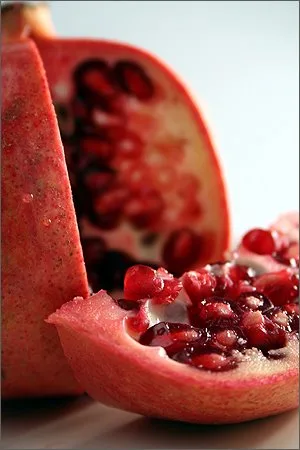
Getting the blood-red juice out of the seeds is a potentially messy process. I managed to make it spurt over a wide area merely by cutting the fruit open. Some recommend squeezing the fruit like an orange - experiments at your own risk, because the danger of splashing is obvious. Perhaps the neatest method is to press and roll the fruit all over and then make a hole in it to let the juice out, but I put more faith in the more brutal way of cutting the fruit into quarters, crumbling the seeds out of their compartments and then squeezing them through cheesecloth into a bowl.
Some grenadine recipes draw the juice from the seeds with sugar, the way jam is made, but the fruit is sweet enough in itself that I did not want to add any more sugar at all. In the end I cheated by boiling the syrup from ready-pressed unsweetened juice from the shop and saving the fruit itself for a fruit salad. I boiled the lime and pomegranate juices down gently and took the pan off the heat the moment the mixture began to turn syrupy. The juice is so sugary that I accidentally caramelised the first batch onto the bottom of the pan, because I was listening too closely to Peter Elk, who had election fever and was reading aloud Osmo Soininvaara's analysis of Halonen and Niinistö, the two candidates left in the Finnish presidential election.
Grenadine syrup can be used to flavour both food and drinks. A grenadine spritzer, for instance, takes grenadine syrup, white wine and soda water, and the syrup also makes a stylish martini. Grenadine would go well with ice cream or puddings too, or, with the help of white wine vinegar, it can be turned into a salad dressing along the lines of raspberry vinegar. I put my syrup into a fruit salad, where its refined flavour was perhaps rather too thoroughly drowned.

Recipe card
Grenadine Syrup
- Boiling 5-10 min
You will need
| a couple | of pomegranates, or a few hundred millilitres of pomegranate juice |
| 1 | lime or lemon, juice only |
Method
- If you are using whole pomegranates, cut them into quarters, crumble the seeds out of their compartments and squeeze them through cheesecloth into a bowl.
- Combine the lime juice and the pomegranate juice and boil them down gently for 5-10 minutes.
- When the mixture begins to turn syrupy, take it off the heat at once and leave to cool.
Recipe card
Pomegranate Fruit Salad
- Chilling at least 1 hour
You will need
| 1 | pomegranate, seeds only |
| 1 | blood grapefruit |
| 1-2 | oranges |
| fresh strawberries or raspberries | |
| a couple | of bananas, sliced |
| (fresh pineapple) | |
| (a couple of tbsp grenadine syrup) |
Method
- Remove the membranes from the citrus fruit and cut the flesh into bite-sized pieces.
- Halve the pomegranate and scrape the seeds into the salad.
- Add the other berries and fruit (and the grenadine syrup, if using).
- Leave to stand in the cold for at least an hour before serving.
3 comments
Raamattu ei tosiaan kerro, mikä hedelmä valtapelissä oli kyseessä. Yleisestihän ajatellaan se olisi ollut omena tai siis granaattiomena, kuten Anna totesi. Juutalaisuudessa opetetaan, että hedelmä on voinut olla viinirypäle, viikuna tai sitruuna. Sitruuna kuulostaa kyllä hauskalta. Eräs islamilainen traditio taas opettaa, että hedelmä on ollut banaani ja lankeemuksen jälkeen heebot olisivat peittäneet itsensä banaanin- eikä suinkaan viikunanlehdillä (http://www.semissourian.com/story.html$rec=140697)
Siirryn välittömästi kannattamaan hyvän ja pahan tiedon banaania!
Amerikasta käsin sitruuna ei kuulosta kovin lupaavalta, termi "lemon" kun täällä merkitsee maanantaikappaletta. Vaikka sitruunafani olenkin (Antti muistatko vielä kun tapoit mun siemenestä kasvatetun sitruunapuun?).
Minkä sitruunapuun? Sitä tikulla silmään, joka vanhoja muistaa... O:)