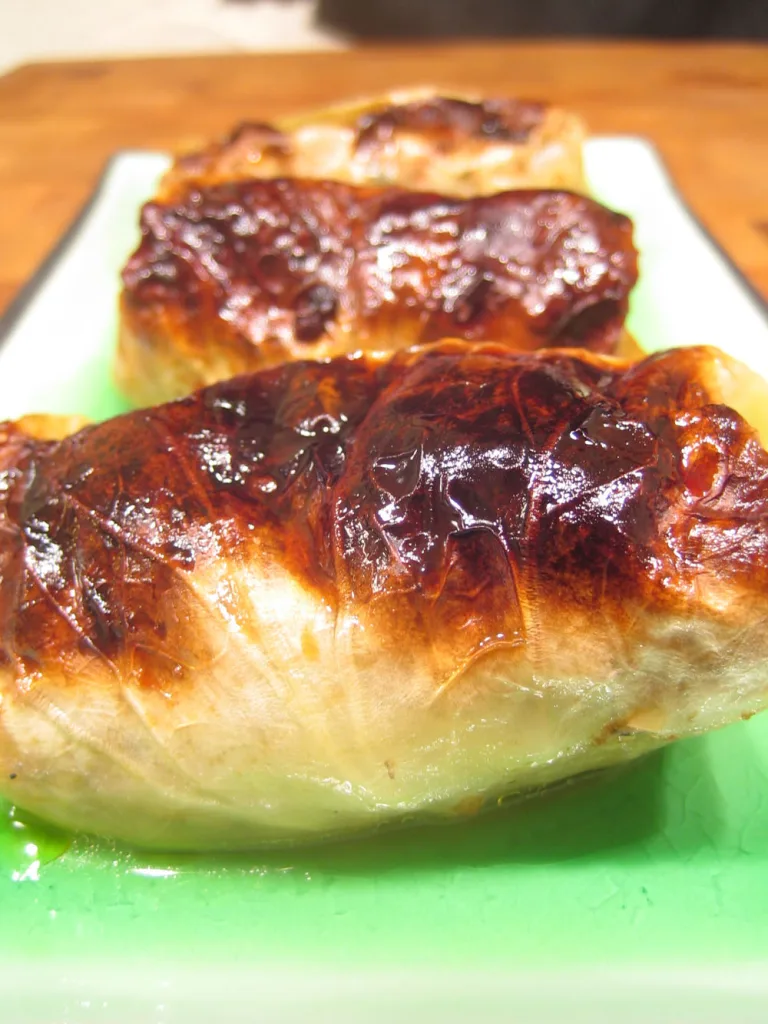
Cabbage rolls are good on a cold winter's day, but I have never really liked the dryish, hard filling of rice and mince in rolls made the "traditional" way. Last Saturday I went to Knossos, the Greek restaurant in the old Hietalahti market hall in Helsinki, and had some good stuffed vine leaves there. That set me thinking about cabbage rolls with a rather more exotic filling.
The Swedish-Finnish cabbage rolls we know have an interesting history. In 1709 King Charles XII of Sweden lost the most famous battle of the Great Northern War to the Russians at Poltava, in eastern Ukraine. From Poltava he fled to Moldavia, which was then in Ottoman hands. At its height the Ottoman Empire held a large part of the Mediterranean coast, present-day Greece and Turkey included. Charles spent several years in exile on Ottoman soil. During that time he tried to persuade the Ottomans to go to war against Russia, and borrowed money from them to carry on his own war.
When Charles went back to Sweden, a group of Ottoman moneylenders followed him to make sure the debts were repaid. They lived in Stockholm from 1716 to 1732, and in those years cabbage rolls, kåldolmar in Swedish, became familiar on Stockholm dinner tables. Dolma is borrowed straight from Turkish and literally means something stuffed. At first the rolls were made with vine leaves in Sweden too, but the wrapping soon changed to cabbage, which was easier to come by. I read that the first Swedish recipe is in Cajsa Warg's cookery book of 1765, and that it, too, rolls the filling in vine leaves. She suggests cabbage leaves only as a substitute, because vine leaves were expensive.
In these Greek-style rolls barley takes the place of the rice, and lamb mince, feta, mint and honey move the flavour towards the Mediterranean. The vegetables, feta and honey keep the filling moist, so it has no chance to dry out hard. Finnish cabbage rolls usually get a drizzle of syrup on top, and here maple syrup does that job, with pink peppercorns crushed over it. The most laborious part was getting the leaves off, with the cabbage boiling in the pan and the leaves to be lifted one at a time with a slotted spoon into cold water as they loosened. In the oven the syrup roasts, and the rolls in the picture are dark brown and glossy on top.
Those readers who did not fall asleep or turn the page during the history lesson are rewarded with a recipe borrowed, with a few changes, from Finfood, the Finnish food information service.
Recipe card
Greek-Style Cabbage Rolls
- about 25
- Stewing in the pan about 10 min
- Oven 200 °C
- In the oven first until the rolls take colour, then about an hour with the stock
- Energy about 85 kcal a roll
You will need
| 2 kg | white cabbage (one 2 kg head) |
| 100 ml | pearl barley (quick-cook broken grains are fine) |
| 1 | onion |
| 2-5 | garlic cloves, to taste |
| 1 | kohlrabi the size of a small fist |
| 1 | red pepper |
| 400 g | minced lamb |
| 1 | pot of fresh mint |
| 2 tsp | thyme |
| 2 tbsp | honey |
| black pepper | |
| white pepper | |
| 200 g | feta |
| salt | |
| soy sauce | |
| maple syrup | |
| 200 ml | meat stock |
| pink peppercorns | |
| port |
Method
Filling
- Cook the barley according to the packet instructions.
- Peel the onion, garlic and kohlrabi and cut them into small dice. Dice the pepper too.
- Brown the mince and add the vegetables to the pan. Leave to stew for about 10 minutes.
- Season the mixture with chopped mint, thyme, honey and black and white pepper, and add soy sauce to taste.
- Stir in the cooked barley and the crumbled feta. Taste and check the salt.
Cabbage leaves
- Fill a pan three quarters full with water and bring it to the boil.
- Hollow out the stalk and core of the cabbage and lower it into the boiling water.
- As the leaves begin to come loose, lift them out with a slotted spoon into cold water.
- Take the leaves out of the cold water and cut away the thickest part of the rib.
Rolling and baking
- Fill each leaf with a generous tablespoon of filling and roll it up. Lay the rolls side by side in an ovenproof dish.
- Drizzle a thin trickle of syrup over the rolls and crush pink peppercorns over the top.
- Bake the rolls at 200 °C. When they have taken on a little colour, pour the stock into the dish and carry on baking for about an hour. Baste with the stock a couple of times.
- Just before serving, pour a splash of port over the rolls to finish the flavour.
The rolls keep in the fridge for a few days and freeze well. I am happy to eat them cold, straight from the fridge, too. Made to this recipe, one roll has about 85 kilocalories, so the dishful in the picture, three rolls, comes to a little over 250.
5 comments
Mmmm - kaalikääryleet:) I should try these soon.. Thanks for the recipe, Antti - I missed this one at Finfood site.
Tuo historiaosuus oli oikeasti kiinnostava. En tiennytkään, että kaalikääryleet ovat kehittyneet viininlehtikääryleistä.
Ja tuo kaalikäärylekuva on superhieno.
pille: you're welcome; your blog has inspired me more than enough 🙂 And don't be shy with the port - it really gives the cabbage rolls a nice final touch.
rosmariini: kiitoksia - kuva meinasi jäädä ottamatta, kun kylässä ollut ystävä ei jakanut ollenkaan innostustani eikä ymmärtänyt ruokakuvauksen viehätystä. Kovetin kuitenkin korvani ja jatkoin räpsimistä pienestä nalkutuksesta huolimatta 😛
aaaargh miten mun alkokaan tekee mieli äidin kaalikääryleitä :9
Mulla olis vielä yksi tuolla jääkaapissa jäljellä - monipäiväisen käärylemaratonin jälkeen mielihalu tuli täytettyä ja nyt ne alkaa tulla korvista ulos 😉