A week is nowhere near enough when the ground to be covered is an enormous country where one advanced civilisation after another has arisen. We skipped the beaches, the mountain villages and the rainforests, and concentrated on the urban bustle of the capital and of Puebla.
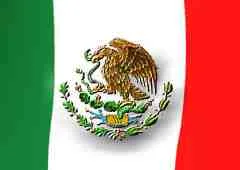
The country's food culture is original and ancient. Even on the Mexican flag an eagle hangs about on top of a cactus, gobbling a snake. We ate on pavements, at stalls lit by neon tubes, in fast-food joints, bakeries, tourist traps and yuppie restaurants. What we ate was usually delicious, but it hardly resembled the "Mexican food" served in Mexican restaurants elsewhere. (On the strength of my trips to Texas I have begun to believe that, by order of the USDA, the flavour is removed from Mexican food at the border, and the result is Tex-Mex.)
What stuck to my fingers from Mexico City, above everything else, was the sweet combined smell of fresh corn tortilla and lime. It was hypnotic to loiter over a slow lunch at a people's restaurant on the pavement and watch a policeman fold his bulletproof vest and his rifle into a corner, out of the way, and a teenage girl pat corn dough into balls, flatten them between plastic bags in a tortilla press and bake them on a hot metal plate into soft tortillas, which soon reach our table wrapped in a napkin.
The very Mexican thing to do with whatever food was set down seemed to be to salt it energetically and squeeze lime over it. The sauces salsa verde and salsa roja came with everything too, in Puebla often in a chocolatey form.
Our trip was very short, and many essential delicacies went untried. These are the most memorable Mexican flavours that reached my glass and my plate.
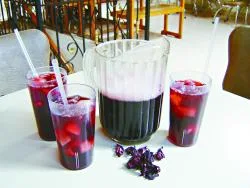
Flor de Jamaica is the dried red flowers of the hibiscus, which are made into a squash-like soft drink that is served everywhere. I also ran into the flower as a taco filling. Tamarind juice has a sweet-and-sour taste strangely close to Coca-Cola.
Nopales are the green pads of a cactus, cooked and cut into strips. Grasshoppers were eaten as a nibble or as a tortilla filling. Thanks to their trimmings they tasted good, but their own (non-existent?) flavour was hard to make out through the garlic and chilli. Perhaps there were nastier seasonings too, since on the US side the sale of dried grasshoppers from Oaxaca has been restricted because of the high levels of lead and mercury measured by the authorities.
Pozole is a warming, filling soup based on salsa or meat stock, in which there were huge swollen kernels of corn (a bit like wet popcorn) underneath shreds of meat, onion, radish, oregano, chillies and strips of lettuce. The goat had been braised in parcels until it fell apart. There was no shortage of odd bits. Forget plain roasts and fillets, because in Mexico the carcass was used thoroughly. Out of my starter broth a whole chicken liver bobbed up into my spoon as a titbit, veins and all. Huitlacoche is a fungus that grows on the corn cob. It looked and tasted like the mould in a blue cheese and was delicious as a stuffing for meat, say.
Every single family seemed to be lugging home for Epiphany a rosca de reyes, a butter-bun wreath decorated with candied fruit in the colours of Mexico. Carrying it took a contraption like a big pizza box, usually half a metre to a metre across. A boundless fondness for diminutives showed in the language and also, to my surprise, on the beer shelf of the shop, where many of the bulk lagers could be had in a cute dwarf version. Coronita was probably the commonest, but I also enjoyed a dark little Indio with my Epiphany wreath.