A delicious-looking pepper steak on the Pastanjauhantaa blog made my inner anti-vegan raise its head, and sure enough the craving for meat woke with it. When I lived in Boston I even had something of a name as a ruthless anti-vegan (Antti eats anything with a face!).
Many people like fillet and sirloin because they are lean and tender. My own favourite, though, is entrecôte. Its connective tissue is soft, and the generous marbling keeps the meat juicy. I also find entrecôte more aromatic than either of the other two. In America my greatest treat was prime rib, which is entrecôte roasted in one big piece, and Stockyard, my favourite steakhouse in Boston, served it with horseradish sauce.
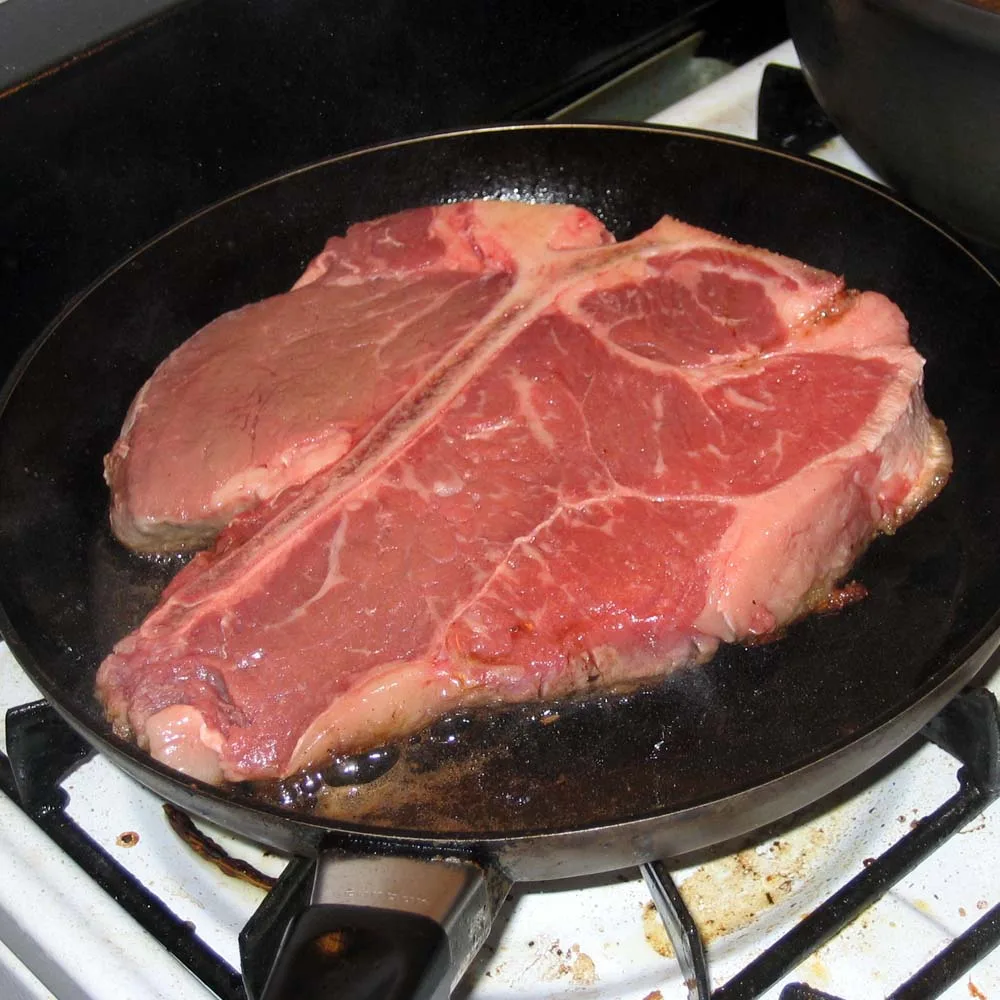
Not that fillet and sirloin are wasted on me. Best of all at the same time, as in the porterhouse steak in the pictures. In this fine treat for meat aficionados there is a fillet steak on one side of the T-shaped bone and a sirloin steak on the other. A porterhouse is in fact a T-bone steak cut from the best spot, so that the fillet steak is as big as it can be. It turned out that the Americans have defined the matter to a fraction of an inch. Only a steak whose fillet side measures at least 1.25 inches at its widest, a good three centimetres, may be called a porterhouse. Anything narrower is an ordinary T-bone.
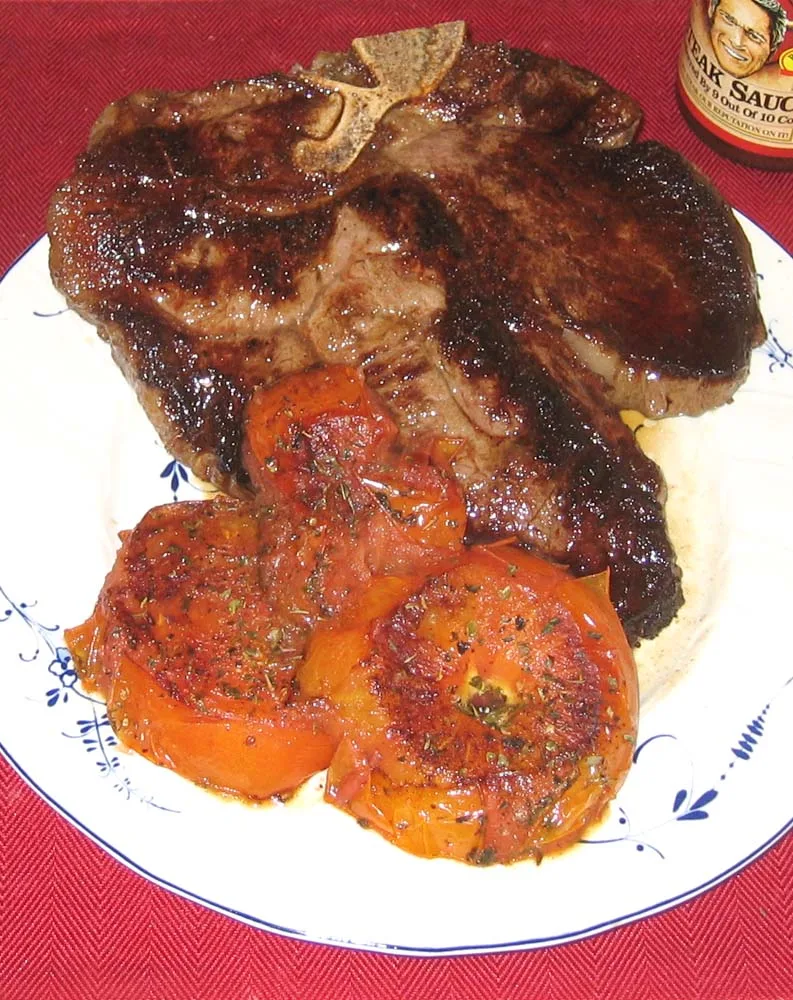
The steak in the pictures filled the frying pan almost from edge to edge, and once fried it covered most of the plate. To go with it I fried some tomatoes and sprinkled dried herbs over them, and on the table there was Paul Newman's steak sauce.
There are several stories about the name. I read that in nineteenth-century America a porter house was a tavern that sold porter and food, and that the steak is supposed to have been named after one of them in New York. According to another story the name came from an innkeeper called Zachariah Porter in Cambridge, right next door to Boston. Apparently nobody has been able to prove either.
There is not much point in looking for T-bone steaks, let alone porterhouses, in ordinary supermarkets, but it is worth asking at the butchers in the market halls, such as Reinin Liha in the Hakaniemi market hall in Helsinki.
Because of Creutzfeldt-Jakob disease, or mad cow disease as it is more familiarly known, many European countries no longer allow even T-bone steaks to be sold, since the bone in them is a piece of the backbone, split lengthwise. In Finland the law is apparently not quite as strict, as slaughterhouses are permitted to separate the nerve tissue from the backbone. Retailers may no longer do this, so for that reason too the steaks have become considerably harder to find. But if you do manage to find a porterhouse somewhere, by all means buy it, and feast on it with, say, fried tomatoes seasoned with herbs and a good steak sauce!