Brioche Helsinki - New York All Night Long

a French recipe that slid back into Finnish pulla

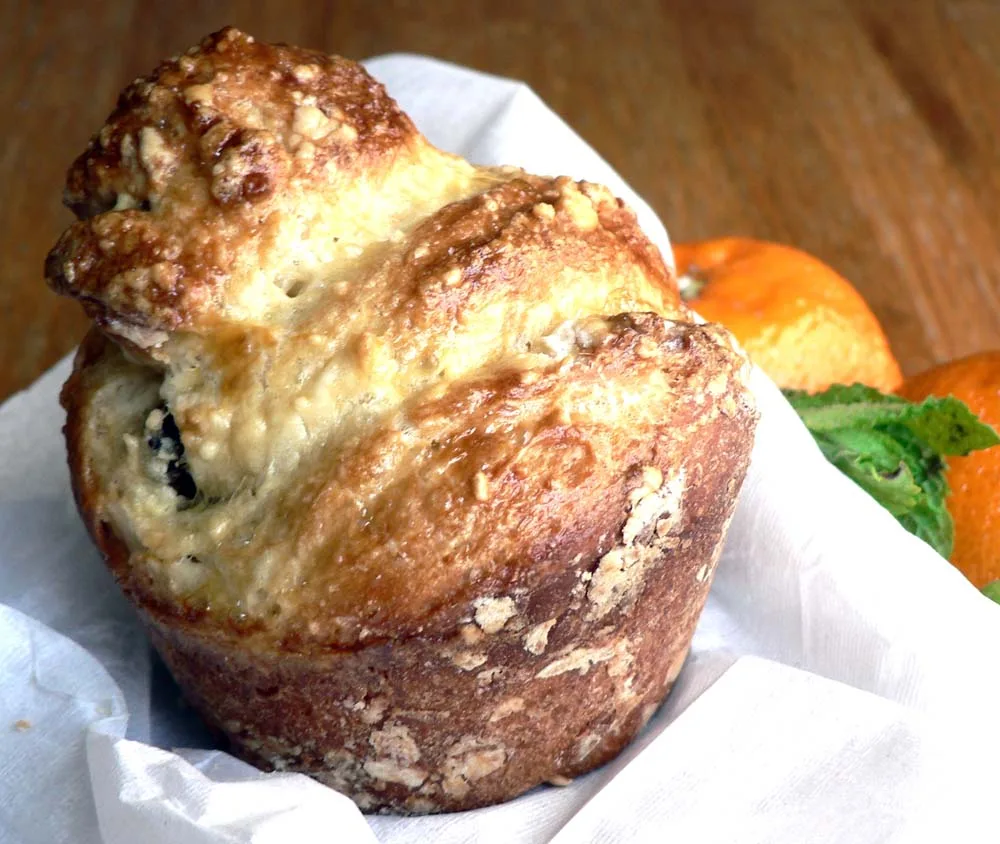
A small golden brioche with a lopsided ball on top, on a white paper napkin on a wooden table, with clementines and mint leaves behind it.
a brioche with its Parisian head

Living in New York, I am constantly homesick for good bread. In my neighbourhood bodegas the bread is suffocated in plastic, and the sweet stuff comes from Entenmann's and would survive a nuclear winter. A Dominican bakery a couple of blocks from us does bake fresh pastries every day, but the bakers there are rather heavy-handed with artificial flavours and food colourings. "Artisanal" bread is sold in most gourmet markets, which almost invariably means sourdough, and that is not the flavour I look for in white bread. Four or five dollars for a baguette that is stale in a day does not thrill me either. Besides, the entire concept of gourmet bread is just plain silly. Good bread should be available everywhere.

We do it in Finland too, of course, drowning a splendid bread tradition in supermarket plastic bags on far too flimsy grounds. But I grew up in a house that smelled of pulla, the Finnish sweet yeast bun, on häälimppu loaves still warm from the Elanto co-operative bakery, and there are times when I miss proper bread painfully. Sour rye crispbread, hapankorppu, is in every supermarket here, but a good mixed-grain loaf and often even ordinary white bread are hard to come by.

The white bread that best suits a Finnish palate comes from Portuguese bakeries, and Portuguese bread can't be beat. The nearest ones I know of, however, are a subway and a train ride away in Mineola on Long Island and in Newark, New Jersey, which is a bit like taking the train from Helsinki to Hyvinkää, fifty kilometres up the line, for one's daily bread. The lovely Greek bakeries of Astoria satisfy all my cravings and are much closer, but even they lie at the far end of the jam-packed, snail-paced M60 bus.

I learned to bake yeast bread before I started school, and yeast dough takes time. Now there was a long President's Day weekend, and a frost hard enough to make me want to keep the hectare-sized American oven on. (For about six months of the year the heat and humidity make the oven a painful thought here.) So I finally decided to do something about my cravings. Inspired by the brioche pictures at La Tartine Gourmande, I started mixing recipes for French brioche and kouglof. But since I picked up the tricks of pulla dough when I was very small, I inevitably slid off the pedantically exact French recipes and onto more familiar tracks. I was aiming for the brioches I used to buy at the pastry counter of Stockmann, the Helsinki department store.

In my minuscule Manhattan kitchen the dough rises in the sink. I fill it with hot tap water and set the bowl afloat in it, and in half an hour to an hour the dough has doubled. I rolled mine into a rectangle on a floured plastic cutting board, scattered it with the rum raisins and the almond slivers and rolled it up like cinnamon buns. I cut the roll into six and put five pieces into a buttered muffin tin. The sixth I cut into five and rolled into tiny balls to sit on top of the big pieces in imitation of Parisian brioches.
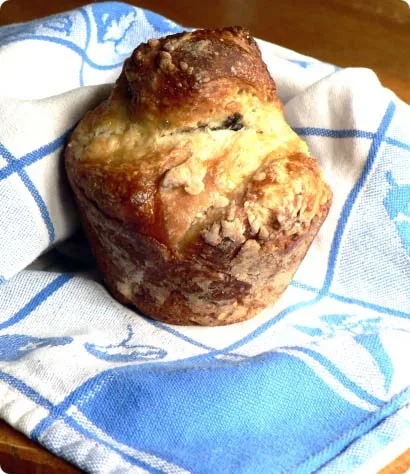
A brioche on a blue-and-white checked tea towel, its sides dark brown from the tin and a raisin showing in the spiral.
the sides darkened in the tin

I ate mine warm with Swedish raspberry and blueberry preserve, the kind known as queen's jam, from the IKEA in New Jersey.

Recipe card

Brioche

  • 5 mini brioches
  • Rising 30-60 min in a warm water bath, or overnight in the fridge
  • Second rising 30 min
  • Oven 175 °C / 350 °F
  • Baking about 20 min

You will need

500 gplain (all-purpose) flour
25 gfresh baker's yeast, or one sachet of active dry yeast
2eggs
100 gbutter, at room temperature, cut into little pieces
1 tspsalt
65-85 gsugar
75 mlwarm (but not too warm) milk

Filling and glaze

100 mlraisins
2 tbspdark rum
a handful of almond slivers
1beaten egg for basting

Method

  1. Make a yeast dough just as you would for pulla. Mix the flour and the active dry yeast. Add the warm milk, salt, sugar and one of the eggs, and mix vigorously. Add the other egg and knead for 5-10 minutes, then add the butter. (If you are using fresh baker's yeast, which I prefer whenever I can get it, crumble the yeast into tepid milk, then add the salt, sugar and flour.)
  2. Add a bit of flour or milk if the dough feels too dry or very runny. Knead until the dough comes away from the bowl. Cover with a tea towel.
  3. Leave to rise until doubled in size, twice if you want to improve the flavour of the brioches. My favourite method is to fill the kitchen sink with hot tap water and put the bowl in the water (it will float): the dough will rise in 30-60 minutes. If you let the dough rise overnight in the fridge, take it out at least 1.5 hours beforehand, so that it reaches room temperature before you shape it.
  4. Let the raisins soak in the rum in the meantime.
  5. When the dough has doubled, punch it down and sprinkle it with a little extra flour to get a ball of dough that is not sticky. Roll it out into a rectangle. In my minuscule kitchen I do this on a clean, lightly floured plastic cutting board of 40 x 30 cm.
  6. Sprinkle the almond slivers and the raisins (and possibly a bit of extra butter) on top of the dough, then roll it up like a Swiss roll or cinnamon buns, starting from the longer side. Cut into six pieces.
  7. Butter a muffin tin (I used one that has six 9 cm / 3.5 in cups) and put five pieces into the cups. If you wish to make Parisian-shaped brioches with small heads, cut the sixth piece into fifths, shape them into balls and fuse them on top of the bigger pieces.
  8. Baste with beaten egg and let rise for 30 minutes.
  9. Bake at 175 °C / 350 °F for about 20 minutes or until golden.
  10. Serve warm, on their own or with good jam.

The blog has just switched to English, but I have written this one in Finnish as well. Blogging is my main way of keeping up something other than an Instant Messenger style in my mother tongue, so I am not giving up posting in Finnish altogether just yet.
10 comments

  1. Chili&Vanília

    Anna,
    fantastic picture!!And I'm so glad you decided to write bilingual post (which is of course double effort I know!).By the way, I'm coming to NY in March, let me know if I should bring you some good bread from Europe:)

  2. Anna

    Definitely let me know when you hit New York. There are so many places you should visit here if you have any spare time! I'll be in Finland for the first three weeks of March though 🙁

  3. Chili&Vanília

    Thanks Anna,
    in fact, I lived in New York for a while so I have a quite exact plan. Foodwise too, of course:)

  4. Pille

    Nice brioche-pulla, Anna!
    Do you know how to make Dallas-pulla? These are really popular in Estonia, I think Fazer Bakery makes them. I have one recipe, but thought that maybe you have a more traditional one..

  5. Antti

    Pille, I *think* Fazer invented both the Dallas & Texas pullas. They're pretty damn good though - my date had one yesterday for dessert 🙂

    Edit: yep... it's got Fazer all over it...

    Ajankohtaista

    14.6.2005 - Fazer Dallaspulla on myymäläpaiston suosituin kahvileipä

    Lehdistötiedote
    14.6.2005

    Jo 10 vuotta herkuttelua

    Dallaspulla on käsite. Aidon ja alkuperäisen Fazer Dallaspullan maistaa ja muistaa. Jäljittelemättömän reseptin maun salaisuus on pullan päällä lepäävä mehevän pehmeällä vaniljalla verhottu rahkainen sydän. Fazer Dallaspulla on vähittäiskaupan myymäläpaiston kahvileipäykkönen. Dallaspulla on nyt täyttänyt komeat 10 vuotta.

    Fazer Dallaspullalle on nyt lanseerattu Fazer Bakery "–paistopisteiden kesäkampanjan yhteydessä kätevä kolmen pullan rasia. "”Rasia tuo helppokäyttöisyyttä kahvileivän ostoon. Se on helppo napata mukaan Fazer Bakerysta, ja pullat pysyvät siinä siistinä kotiin asti. Uusi rasia on kätevä viedä mukana myös tuliaisiksi"?, kuvailee Fazer Leipomoiden tuoteryhmäpäällikkö Salla Tenkanen. Hän kertoo, että vähittäiskaupan paistotuotteissa irtokahvileivän ostaminen painottuu aamupäivään ja päivään. "”Iltapäivän asiakas hakee ostamisesta helppoutta, mukaan tarttuu helpommin pakattu tuote kuin irtotuote"?, hän toteaa.

    Dallaspulla syntyi Texaspullan sisareksi

    Dallaspulla syntyi kymmenen vuotta sitten Texaspullan sisareksi. Fazer Texaspulla sai alkunsa Fazerin tuotekehittäjän Tapani Mäkäräisen Amerikan matkan tuliaisina. Hän oli tutustumassa pakastetuotteisiin ja matkan tuloksena syntyi cinnamon roll suomalaisittain. Tuolloin Mäkäräiselle sanottiin, että parempaa pullaa turskin voi toivoa enää keksivänsä. Mieleen kuitenkin jäi ajatus: "”Joku pulla jossakin vaiheessa vielä tehdään. Ja siitä tulee vielä parempi."?

    Eräänä yönä Tapani Mäkäräinen heräsi aamuyöstä mielessään loistava idea. Hän ryhtyi heti seuraavana aamuna pullan leivontaan, ja tästä syntyi herkullinen uutuus, Fazer Dallaspulla. On hyvin harvinaista, että todellinen uutuus syntyy ensimmäisellä leivonnalla. Tuotteen isä korostaakin, ettei tuotekehitys koskaan ole ollut yhtä helppoa kuin se oli Dallaspullan kohdalla.
    Lisätietoja Fazer Leipomoilla antaa

    Tuoteryhmäpäällikkö Salla Tenkanen
    puh. 020 555 3980
    salla.tenkanen@fazer.fi

  6. Anna

    Hi Pille
    My brioche is a bit pock-marked because active dry yeast was invented to make my life harder - I always mess it up 😉 No wonder so many Americans are terrified of yeast doughs. I'm all for the much simpler living, organic yeast, but it's not easy to find here.

    Have you discovered Axis of Aevil yet? She is an American expat who has rapidly become the queen of Finnish domestic baking on the Internet. (Because she lives in my neighborhood in Helsinki, her wonderful pictures of familiar streets, buildings, and street graffiti also keep my homehomesickness at check.)

    Axis of Aevil did some sleuthing last year and uncovered these fun factoids and a recipe - everything is in English, too. Turns out that dallaspulla is a relatively novel invention: I first came across them at gas stations little more than ten years ago. And you won't find them in Dallas...

    If it's the cinnamony variety you are after, fill the dough with lots and lots of butter and brown sugar. Enjoy!

  7. Anna

    Vau veli. Telepatia on tosiaan meidän ongelma... LOL!

    ZZ

  8. Pille

    Heippa Anna & Antti -
    thanks for the comprehensive overview and superquick reply! The recipe I've got for Dallaspullat is from Tapani Mäkäräinen himself (well, via Kokkivieras 12.9.2002 & http://www.ruokala.tv), and I've also got a recipe for "Manteliset dallaspullat" from Pirkka-lehti, helmikuu 2004. Not sure which one I should try first. Choices, choices!
    Haven't had a chance to try Texas-pulla yet - it's yet to conquer the Estonian market, I guess..

    PS Antti - thanks for your nice words about missing my white apron picture:) I've suddenly become very camera-shy and decided my blog should be more about my food than myself..

  9. Antti

    Pille, if you like Dallaspulla, I'm sure a Finnish rahkapulla - or even rahkapiirakka - will blow your mind away. I'd be surprised though if you didn't have those in Estonia already; all sour milk related food seems to originate from our beloved Eastern neighbour...

    But if you're fancying Texaspullas, I'd seriously suggest you to look towards the states! Nothing - I mean nothing - is more delicious than a sugar and butter dripping, glazed American cinnamon roll. And that is, after all, where Mr. Mäkäräinen got the idea for his Texaspulla.

    If you're heading stateside, book a room at Holiday Inn. Their breakfast buffet includes super good cinnamon rolls 🙂

  10. Pille

    Antti, we've got Dallaspulla alright - as well as many delicious "native" rahkapulla or rahkapiirakka type pastries. But I think Dallaspulla is lighter in texture and much richer in flavour, more decadent. Back home I just buy them from any supermarket that stocks Fazer products, here in Edinburgh I need to bake them myself:)

Leave a Reply

Your email address will not be published. Required fields are marked *