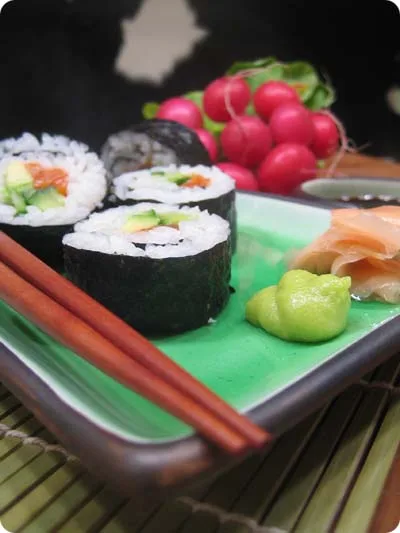
After years of delaying tactics I have made the first maki roll of my life. Yay!
I can't remember when I first ate sushi, or Japanese food at all. I do know where - Kabuki on Lapinlahdenkatu in Helsinki - and since it has been at the same address for more than fifteen years, I think my first try must have been about ten years ago. Somewhere between upper secondary school and my first year at university, anyway. At home we always ate cured fish, so the idea of raw fish never put me off. The rest of Japanese cooking, the cooked dishes, came as a pleasant and tasty surprise.
In Finland sushi is still sadly expensive, although there have been Japanese restaurants, in Helsinki at least, for close to twenty years now. So there should be no novelty mark-up left in the prices. Sushi has grown steadily more popular, and these days even supermarkets sell perfectly decent ready-made sushi. Unfortunately, to my mind, that costs far too much as well.
Since the ingredients for sushi cost very little, I have been planning for years to make it myself. I bought some of the equipment, optimistically, years ago, but on Thursday I decided at last to make the dream come true, and braving a light frost I set off for Tokyokan, the Japanese shop on Annankatu. With the owner's kind help I soon had the right rice and vinegar mix, and the other things I needed, such as a bamboo mat for rolling maki. Chatting about Japanese food and whatnot, I stood there talking for half an hour without noticing. Among other things I heard about his career in business, which he started at 23, and about Tokyokan's spotless record with customs. Because of that record they sell, for example, no frozen Japanese fish at all.
In America I took to California rolls, maki filled with avocado, cucumber and (imitation) crab. Little known in Japan, this maki was first made for Californians who shied away from raw fish, but it has since become perhaps the most popular maki in the world. And why not, it tastes good.
Instead of fake crab sticks I bought cold-smoked salmon, and I decided not to roll the maki inside out, though a California roll traditionally is. As a first-timer I wanted to start carefully, and it gave me a good excuse to cut a few calories by leaving out the sesame seeds. The Americans decorate the outside with orange, very fine flying fish roe, but Tokyokan did not have any.
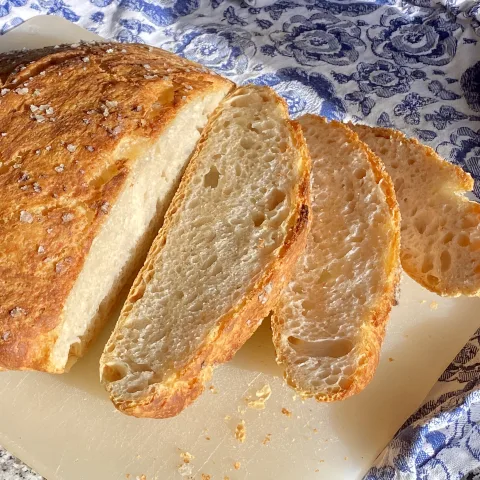
Cooking the sushi rice turned out to be a surprisingly trivial operation, and soon my first nori, a sheet of toasted seaweed, was lying on the bamboo mat and a layer of cling film, waiting to be filled. Wet fingers are essential for handling the astonishingly sticky rice, and so is restraint: the worst mistake is to put too much rice on the nori. The right layer is one that lets plenty of nori show through. Next I laid slices of avocado, cucumber and salmon on the rice, and then it was time to roll. As I held the filling together carefully with my fingers, the roll took shape surprisingly easily. The picture below is my very first roll, its ends not yet trimmed.
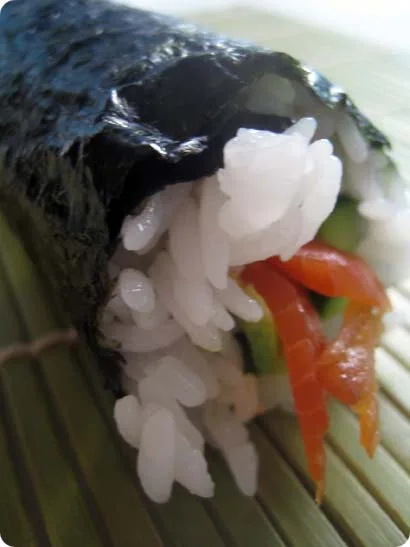
Four decilitres (400 ml) of uncooked rice, one avocado, not quite a whole medium cucumber and a 150 g pack of smoked salmon made six whole rolls, each of them eight finished pieces of maki. The ingredients came to about 7.50 euros in all, so each piece cost a little over 15 cents.
Recipe card
Smoked Salmon Maki
- 6 rolls, 48 pieces
- Makes 6 rolls of 8 pieces each
You will need
| 400 ml | sushi rice (uncooked) |
| sushi rice vinegar mix | |
| nori sheets (toasted seaweed) | |
| 1 | avocado |
| just under | a medium cucumber |
| 150 g | cold-smoked salmon |
Method
- Cook the sushi rice and season it with the vinegar mix.
- Lay a nori sheet on the bamboo mat over a layer of cling film.
- Spread the rice on the sheet with wet fingers, thinly enough for plenty of nori to show through.
- Lay slices of avocado, cucumber and salmon on the rice.
- Roll carefully, holding the filling together with your fingers.
- Trim the ends of the roll and cut it into eight pieces.
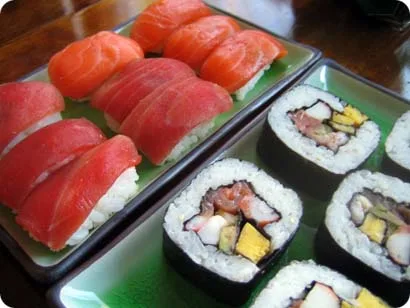
The picture above shows the tuna and salmon nigiri I bought at the opening of the K-Supermarket in Lauttasaari, and maki sold as California rolls (which they were not). As an opening offer they were 0.60 euros apiece, but the normal price is 0.80 for the maki and a staggering 2.40 for the nigiri. Quite a difference from my own! Apart from the price I really have no complaints about these supermarket sushi, which were honestly good. I seem to remember that one of the labels named the maker as BOF Oy, which according to Google is the same company as Best Oriental Food Oy. Decent sushi, but too expensive if you ask me 🙂
In America sushi was often fairly expensive, depending on the place, but there were exceptions. In Boston and New York I often ate Japanese food from the buffet at the Minado restaurants. For about twenty dollars, or 17 euros, you could eat to your heart's content from dozens of different kinds of sushi and sashimi, crabs, oysters, salads, hot dishes and desserts. Pretty good value for money, then.
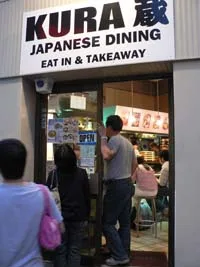
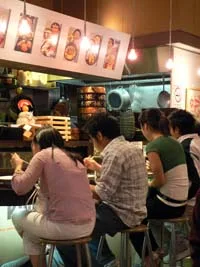
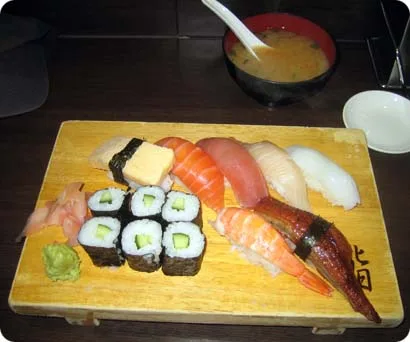
Cheap Asian food is part of everyday life in many of the world's big cities, Sydney among them. Over New Year I ate Japanese there a couple of times, as I could not walk past an inviting-looking restaurant with local Japanese crowding its doorway. Kura, a name that makes a Finn smile since kura is our word for mud, is on the busiest spot in Sydney's Chinatown, a block from George Street, the city's main shopping street. It has only fourteen seats, and there is a constant bustle outside the door as customers wait their turn to get in. Best of all, the generous servings of sushi hardly dented my wallet: six euros bought more than ten pieces of sushi and a bowl of miso soup (picture below).
Helen of Grab Your Fork has written a nice post about Kura, with a set of delicious photos. Worth a look!
2 comments
Hairahduin viime kesänä ottamaan tosi tavallisennäköisen sushilajitelman mukaan sen enempää hintoja miettimättä Stockalta - hinta kassalla €14 tjsp. So not worth it. Eli jos vaan jaksat näprätä ansaitset omaisuuksia...
Suomalaisen supermarketsushin pahin vika on että nigirien kala on vähän seisoneen oloista - bakteerifluoresessi kalan pinnassa ei erityisesti lisää ruokahalua. Tosi tuoreen kalan saatavuus on muutenkin vähän niin ja näin, joten usein tulee päädyttyä kylmäsavukirjoloheen. Oox kokeillu sorva- ja sulkavasushia 😉
Uhh, (mädät) sorvat ja sulkavat ui vieläkin mun uniin. Sushikeisari, joka toimittaa valmis-susheja ainakin mun lähimarkettiin, on kuulemma ihan katu-uskottava establishmentti. Yhdeksän vuotta japanissa asunut Pirjo ainakin tilaa sushinsa sieltä. Kaupoissa olevien palojen tuoreus onkin sitten eri juttu, mutta mun ostamat oli kyllä ihan jees. Pimeässä hehkuvat on kyllä aika turn off 🙂